

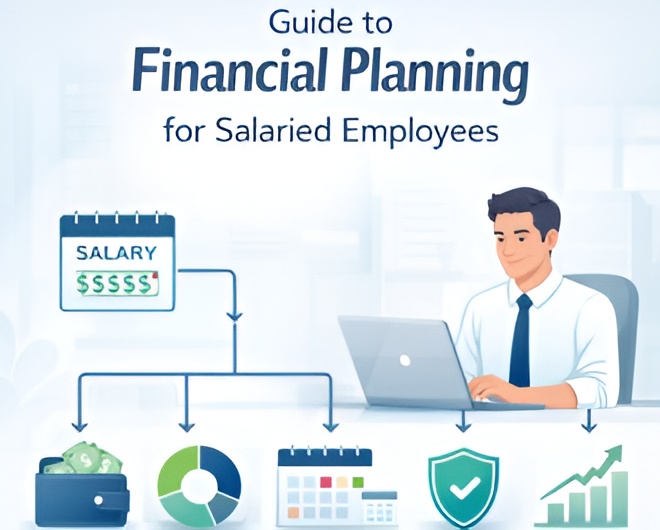
Guide to Financial Planning for Salaried Employees
8 Step Smart Financial Planning for Buying Your First House Buying your first home is a complex puzzle where the “sticker price” is only the first piece. To ensure your home is a wealth-building asset and not a debt trap, you need a high-resolution financial strategy. Here is the 8-step master plan to navigate the financial landscape of buying your first home. 1. Step 1: The “Audit” – Establishing Your Real Affordability Before looking at properties, look at your net cash flow. Banks use a Fixed Obligation to Income Ratio (FOIR) to decide your eligibility, and you should use a stricter one for your peace of mind. The 30% Hard Ceiling: Your monthly EMI should never exceed 30% of your net take-home pay. If you earn ₹1.5 Lakh, your EMI must stay under ₹45,000. CIBIL Health Check: In 2026, lenders offer “risk-based pricing.” A score of 750-800+ can get you an interest rate that is 0.50% lower than someone with a score of 700. Over 20 years, this 0.5% difference can save you ₹10–15 Lakh. Existing Debt Clearance: Close small liabilities like car loans or credit card EMIs at least 6 months before applying. This “cleans” your debt-to-income ratio, allowing for a higher home loan limit. Step 2: Factoring in the “Transaction Delta” (Hidden Costs) A common mistake is saving only for the 20% down payment. In the Indian market, the “Agreement Value” is far from the “Final Cost.” Statutory Charges: Budget 5–7% for Stamp Duty and 1% for Registration (varying by state). The GST Factor: If the property is under-construction, add 5% GST (1% for affordable housing). Ready-to-move-in homes are GST-exempt. Ancillary Costs: Factor in 1–2% for Brokerage (if applicable) and ₹50,000–₹1,00,000 for legal due diligence and processing fees. Step 3: The “Aggressive” Down Payment Model While banks fund 80%, smart buyers aim for 25–35%. Why? A higher down payment reduces your “Loan-to-Value” (LTV) ratio, which can qualify you for the bank’s most competitive interest rates. The Savings Mix: If your purchase is 2+ years away, use a mix of Arbitrage Funds and Short-Term Debt Funds. If it’s less than 12 months away, stick to Liquid Funds or High-Yield FDs to protect the principal. Step 4: Securing a Pre-Approved “Financial Passport” Don’t shop for a house without a bank’s letter of intent. Bargaining Power: Having a pre-approval letter tells the developer you are a “confirmed buyer,” giving you the upper hand to negotiate a lower base price or freebies like covered parking. Boundary Setting: It prevents “budget creep”—the tendency to look at a slightly more expensive house and convince yourself you can “somehow” manage the extra EMI. Step 5: The “20-Year” Repayment Logic Lenders will push for a 30-year tenure to make the EMI look smaller. Do not fall for this. Total Interest Outgo: On a 30-year loan, you often end up paying back nearly 2.5 times the principal amount. The Sweet Spot: Stick to a 15 to 20-year tenure. The 5% Strategy: Commit to increasing your EMI by 5% every year as your salary grows. This simple hack can finish a 20-year loan in just 12 years, saving you decades of interest. Step 6: Interior Budgeting (The “Bare Shell” Trap) Possession day is not moving day. A new apartment requires significant capital to become a “home.” Standard Estimates: Budget roughly ₹1,000 to ₹1,500 per sq. ft. for basic functional interiors (modular kitchen, wardrobes, lighting, and fans). Liquidity Rule: Ensure you have this amount in cash/liquid savings. Taking a “Top-up Loan” or “Personal Loan” for interiors right after a home loan puts extreme stress on your monthly cash flow. Step 7: The “Insurance Moat” Strategy A home loan is a 20-year liability that your family should not inherit. Avoid Bank HLPPs: Banks often bundle “Home Loan Protection Plans” (HLPP) where the premium is added to the loan. These are expensive and the cover reduces as you pay off the loan. The Term Plan Alternative: Buy an independent Term Insurance policy for the loan amount. It’s cheaper, the cover remains constant, and it stays with you even if you switch your loan to another bank. Step 8: The “Possession Buffer” & Emergency Fund Your financial planning doesn’t end when you get the keys. The Sinking Fund: Societies often ask for a 1–2 year advance maintenance deposit and a one-time “Corpus Fund” payment during possession. This can range from ₹1 Lakh to ₹3 Lakh. The Reset Fund: After buying a home, your Emergency Fund must be recalibrated. It should now cover 6 months of your new expenses, including the home loan EMI, property taxes, and society maintenance. Conclusion: Foundations First The goal of smart home buying is to ensure that the roof over your head doesn’t become a weight on your shoulders. By following these eight steps, you move from being an “aspiring buyer” to a “strategic owner.” WELFIN INSIGHT “The right insurance amount is not the cheapest or the highest it’s the one that fits your life.” January 16, 2026 What are the Tax Benefits Associated with Loan against property? Read More January 16, 2026 Guide to Financial Planning for Salaried Employees Read More January 16, 2026 WHAT ARE THE DIFFERENCES BETWEEN 1ST PARTY INSURANCE AND 3RD PARTY INSURANCE: MOTOR INSURANCE BUYING TIPS Read More Confused about money decisions? Get clarity on investments, insurance & goals in one plan. Check Now Not sure if your insurance is enough? 👉 Get a Free Insurance Adequacy Check Get In Touch
8 Step Smart Financial Planning for Buying Your First House

8 Step Smart Financial Planning for Buying Your First House Buying your first home is a complex puzzle where the “sticker price” is only the first piece. To ensure your home is a wealth-building asset and not a debt trap, you need a high-resolution financial strategy. Here is the 8-step master plan to navigate the financial landscape of buying your first home. 1. Step 1: The “Audit” – Establishing Your Real Affordability Before looking at properties, look at your net cash flow. Banks use a Fixed Obligation to Income Ratio (FOIR) to decide your eligibility, and you should use a stricter one for your peace of mind. The 30% Hard Ceiling: Your monthly EMI should never exceed 30% of your net take-home pay. If you earn ₹1.5 Lakh, your EMI must stay under ₹45,000. CIBIL Health Check: In 2026, lenders offer “risk-based pricing.” A score of 750-800+ can get you an interest rate that is 0.50% lower than someone with a score of 700. Over 20 years, this 0.5% difference can save you ₹10–15 Lakh. Existing Debt Clearance: Close small liabilities like car loans or credit card EMIs at least 6 months before applying. This “cleans” your debt-to-income ratio, allowing for a higher home loan limit. Step 2: Factoring in the “Transaction Delta” (Hidden Costs) A common mistake is saving only for the 20% down payment. In the Indian market, the “Agreement Value” is far from the “Final Cost.” Statutory Charges: Budget 5–7% for Stamp Duty and 1% for Registration (varying by state). The GST Factor: If the property is under-construction, add 5% GST (1% for affordable housing). Ready-to-move-in homes are GST-exempt. Ancillary Costs: Factor in 1–2% for Brokerage (if applicable) and ₹50,000–₹1,00,000 for legal due diligence and processing fees. Step 3: The “Aggressive” Down Payment Model While banks fund 80%, smart buyers aim for 25–35%. Why? A higher down payment reduces your “Loan-to-Value” (LTV) ratio, which can qualify you for the bank’s most competitive interest rates. The Savings Mix: If your purchase is 2+ years away, use a mix of Arbitrage Funds and Short-Term Debt Funds. If it’s less than 12 months away, stick to Liquid Funds or High-Yield FDs to protect the principal. Step 4: Securing a Pre-Approved “Financial Passport” Don’t shop for a house without a bank’s letter of intent. Bargaining Power: Having a pre-approval letter tells the developer you are a “confirmed buyer,” giving you the upper hand to negotiate a lower base price or freebies like covered parking. Boundary Setting: It prevents “budget creep”—the tendency to look at a slightly more expensive house and convince yourself you can “somehow” manage the extra EMI. Step 5: The “20-Year” Repayment Logic Lenders will push for a 30-year tenure to make the EMI look smaller. Do not fall for this. Total Interest Outgo: On a 30-year loan, you often end up paying back nearly 2.5 times the principal amount. The Sweet Spot: Stick to a 15 to 20-year tenure. The 5% Strategy: Commit to increasing your EMI by 5% every year as your salary grows. This simple hack can finish a 20-year loan in just 12 years, saving you decades of interest. Step 6: Interior Budgeting (The “Bare Shell” Trap) Possession day is not moving day. A new apartment requires significant capital to become a “home.” Standard Estimates: Budget roughly ₹1,000 to ₹1,500 per sq. ft. for basic functional interiors (modular kitchen, wardrobes, lighting, and fans). Liquidity Rule: Ensure you have this amount in cash/liquid savings. Taking a “Top-up Loan” or “Personal Loan” for interiors right after a home loan puts extreme stress on your monthly cash flow. Step 7: The “Insurance Moat” Strategy A home loan is a 20-year liability that your family should not inherit. Avoid Bank HLPPs: Banks often bundle “Home Loan Protection Plans” (HLPP) where the premium is added to the loan. These are expensive and the cover reduces as you pay off the loan. The Term Plan Alternative: Buy an independent Term Insurance policy for the loan amount. It’s cheaper, the cover remains constant, and it stays with you even if you switch your loan to another bank. Step 8: The “Possession Buffer” & Emergency Fund Your financial planning doesn’t end when you get the keys. The Sinking Fund: Societies often ask for a 1–2 year advance maintenance deposit and a one-time “Corpus Fund” payment during possession. This can range from ₹1 Lakh to ₹3 Lakh. The Reset Fund: After buying a home, your Emergency Fund must be recalibrated. It should now cover 6 months of your new expenses, including the home loan EMI, property taxes, and society maintenance. Conclusion: Foundations First The goal of smart home buying is to ensure that the roof over your head doesn’t become a weight on your shoulders. By following these eight steps, you move from being an “aspiring buyer” to a “strategic owner.” WELFIN INSIGHT “The right insurance amount is not the cheapest or the highest it’s the one that fits your life.” January 16, 2026 WHAT ARE THE DIFFERENCES BETWEEN 1ST PARTY INSURANCE AND 3RD PARTY INSURANCE: MOTOR INSURANCE BUYING TIPS Read More January 16, 2026 Karma Capital Advisors Private Limited as Portfolio Management Services Read More January 16, 2026 8 Step Smart Financial Planning for Buying Your First House Read More Confused about money decisions? Get clarity on investments, insurance & goals in one plan. Check Now Not sure if your insurance is enough? 👉 Get a Free Insurance Adequacy Check Get In Touch
7 Signs You Need a Financial Planner

7 Signs You Need a Financial Planner In 2026, the financial world is more complex than ever. The gap between “having money” and “building wealth” is widening due to high-speed market changes, evolving tax laws, and the rising cost of living. If any of the following “Big Pointers” resonate with your current situation, it is a clear signal that a professional financial planner is no longer a luxury, but a necessity. 1. The “Wealth-Income Gap” Paradox The Sign: Your salary has increased by 30-50% over the last few years, but your bank balance or investment portfolio hasn’t reflected that growth. The Reality: You are likely a victim of Lifestyle Creep and “invisible spending.” Without a structured plan, your higher income is simply funding a more expensive lifestyle rather than building long-term freedom. How a Planner Helps: They create a “Cash Flow Map” to ensure that every salary hike is automatically diverted into wealth-generating assets before you have a chance to spend it. 2. Navigating the “Tax Complexity” of 2026 The Sign: You are still using “old-school” investment strategies despite the new 12.5% Long-Term Capital Gains (LTCG) tax regime. The Reality: In 2026, tax is your biggest “leakage.” If you aren’t proactively Tax Harvesting (selling and buying back assets to utilize the ₹1.25 lakh annual exemption), you are essentially leaving money on the table for the government. How a Planner Helps: They optimize your portfolio to ensure you pay the absolute legal minimum in taxes through strategic withdrawals and gain-resetting. 3. The “Insurance Illusion” Danger The Sign: You believe you are “well-covered” because your company provides a ₹5 Lakh health policy and a basic life cover. The Reality: In 2026, Employer-Linked Insurance is a Trap. If you lose your job or decide to switch careers, you are suddenly uninsured at an age where buying a new policy is either incredibly expensive or impossible due to health issues. How a Planner Helps: They help you “decouple” your protection from your job, ensuring you have a portable, high-sum insured private cover that stays with you for life. 4. Emotional Volatility and “Market Noise” The Sign: You find yourself checking your portfolio every day and feeling a sense of panic when you see “Red” in the markets. The Reality: 2026 markets are driven by high-frequency trading and viral news cycles, leading to sharper, faster corrections. If you react emotionally by stopping SIPs during a dip, you destroy the power of compounding. How a Planner Helps: They act as your Behavioral Coach. They provide the objective logic needed to stay invested during downturns, which is exactly when the most wealth is actually built. 5. The “Early FIRE” Engineering Challenge The Sign: You want to retire by 45 or 50, but you are calculating your needs based on “today’s prices.” The Reality: Retiring early in 2026 requires Financial Engineering, not just saving. You have to account for a 40-50 year horizon where healthcare inflation is growing at 12-14% annually. A single calculation error can result in running out of money by age 70. How a Planner Helps: They use “Stress Testing” and Monte Carlo simulations to ensure your corpus is robust enough to survive market crashes, high inflation, and a long life. 6. Portfolio Fragmentation (The “Mutual Fund Mess”) The Sign: You own 15+ different mutual funds, 3-4 insurance policies, and some random gold/crypto, but you have no idea what your Overall Annualized Return (XIRR) is. The Reality: You are “Over-Diversified.” Many of your funds likely hold the same stocks, meaning you are paying multiple management fees for the same returns. How a Planner Helps: They perform a Portfolio Consolidation, trimming the “dead wood” and focusing your capital into 4-5 high-conviction “Direct Plan” funds that actually move the needle. 7. Major Life Transitions (The “Pivot” Moments) The Sign: You’ve recently gotten married, had a child, inherited money, or are planning to move abroad. The Reality: Your financial “DNA” has changed. A plan made for a single person is dangerous for a parent. In 2026, legal complexities around Estate Planning (Wills) and international taxation are at an all-time high. How a Planner Helps: They realign your assets, update your nominations, and ensure your legacy is protected through a legally sound framework. Conclusion: Buying Back Your Time Ultimately, the biggest sign that you need a financial planner in 2026 is the realization that your time is more valuable than your money. If you are spending your weekends researching “best mid-cap funds” instead of being with your family or focusing on your career, you are misallocating your most precious resource. WELFIN INSIGHT “The right insurance amount is not the cheapest or the highest it’s the one that fits your life.” January 16, 2026 7 Signs You Need a Financial Planner Read More January 16, 2026 Behind the Scenes: How Fund Management Companies Maximize Returns – Copy Read More January 14, 2026 Behind the Scenes: How Fund Management Companies Maximize Returns Read More Confused about money decisions? Get clarity on investments, insurance & goals in one plan. Check Now Not sure if your insurance is enough? 👉 Get a Free Insurance Adequacy Check Get In Touch
Common first time home buyer Mistakes

10 common financial mistakes first-time home buyers make Buying your first home is one of the most significant emotional and financial milestones in life. It represents stability, achievement, and a permanent place to call your own. However, in the excitement of choosing floor plans and kitchen tiles, it is easy to overlook the complex financial mechanics of a real estate transaction. For a first-time buyer, a single misstep can lead to years of financial stress, high-interest debt, or even the loss of the property. To ensure your dream home doesn’t become a financial burden, here are the 10 common financial mistakes first-time home buyers make and the strategic ways to avoid them. 1. The 2026 Early Retirement “Reality Check” Retiring at 60 is a 20-year problem. Retiring at 45 is a 50-year problem. This massive time horizon creates three distinct “Wealth Killers” that a 2026 financial plan must neutralize: The Inflation Gap: While general inflation is 6%, urban lifestyle costs are rising at 8%. A lifestyle costing ₹1 Lakh/month today will require ₹3.2 Lakh/month just 20 years from now. The Longevity Risk: In 2026, healthcare advances mean many retirees will live into their 90s. Your money has to work twice as long as your career did. The Sequence of Returns Risk: A market crash in the first 3 years of your early retirement can destroy a corpus that would have otherwise lasted 40 years. 2. Calculating Your “FIRE Number” (2026 Adjusted) In the past, the “4% Rule” (25x annual expenses) was the standard. In 2026, given India’s high inflation and new tax slabs, experts recommend a 3.3% to 3.5% Safe Withdrawal Rate (SWR). This requires a multiplier of 30x to 35x your annual expenses. Retirement Corpus Matrix (Based on 3.5% SWR) Desired Monthly Income Annual Expense Total Corpus Needed 25% Health Buffer Incl. ₹50,000 (Lean) ₹6.0 Lakh ₹1.71 Crore ₹2.14 Crore ₹1,00,000 (Comfort) ₹12.0 Lakh ₹3.42 Crore ₹4.27 Crore ₹2,00,000 (Premium) ₹24.0 Lakh ₹6.85 Crore ₹8.56 Crore Note: If you plan to live in a Tier 1 Metro (Mumbai/Bangalore), multiply these figures by 1.2 to account for higher real estate and lifestyle costs. 3. The 3-Bucket Strategy: The 2026 Blueprint A successful early retiree does not just “invest in mutual funds.” They organize their wealth into three distinct “Buckets” based on when the money is needed. This prevents the need to sell equity during a market crash. Bucket 1: The Cash Bucket (Years 0–3) Assets: Liquid Funds, High-yield FDs, Savings Accounts. Role: Your “Salary Replacement.” This bucket holds 3 years of expenses in non-volatile assets. 2026 Strategy: Ensure this bucket is topped up during market “bull runs.” Bucket 2: The Stability Bucket (Years 4–10) Assets: Corporate Bonds, Conservative Hybrid Funds, Arbitrage Funds. Role: The “Refill Engine.” It provides moderate growth (8–9%) with low volatility to refill the Cash Bucket. Bucket 3: The Growth Engine (Years 10–50) Assets: Nifty 50 Index Funds, Flexi-cap Funds, International (US/Nasdaq) ETFs. Role: The “Inflation Beater.” This bucket must grow at 12–15% to ensure you don’t outlive your money. 4. Tactical Execution for 2026 The “Glide-Down” Transition Three years before you plan to quit your job, begin your “Glide-Down.” Stop reinvesting dividends and start moving 20% of your equity gains into your Cash Bucket annually. This locks in your first 5 years of retirement income while the market is still favorable. Decoupled Healthcare Strategy In 2026, 62% of hospital expenses in India are out-of-pocket. Step 1: Purchase a private Family Floater (₹15L base). Step 2: Add a ₹1 Crore Super Top-up. Step 3: Maintain a “Medical Emergency Fund” equal to 10% of your total corpus. The Tax-Harvesting Habit With the 12.5% LTCG tax, you must be proactive. Every year, sell and immediately buy back your equity holdings to “book” the ₹1.25 Lakh tax-free profit. Over 30 years, this simple habit can save you ₹15–20 Lakh in taxes. 5. Summary: The 5 Milestones of Early Retirement Milestone Action Item 2026 Success Metric Level 1 Debt Freedom Zero high-interest loans (Car/Personal/Credit). Level 2 Protection 15x Annual Income Term Plan + Private Health Cover. Level 3 The Foundation 12-Month Emergency Fund in a Liquid Account. Level 4 The Core Reaching 20x Annual Expenses in your Growth Engine. Level 5 Freedom Reaching 35x Annual Expenses + 3 Years Cash Reserve. Conclusion: Freedom is a System, Not a Number Early retirement is not about hitting a “lucky” stock pick or having a massive inheritance. It is a system of asset allocation, inflation protection, and withdrawal discipline. In the volatile economy of 2026, the earlier you build this system, the more control you gain over your time. WELFIN INSIGHT “The right insurance amount is not the cheapest or the highest it’s the one that fits your life.” January 14, 2026 Top 10 Qualities to Look for in a Wealth Management Company Read More January 14, 2026 Common first time home buyer Mistakes Read More January 14, 2026 How to Plan Retirement Read More Confused about money decisions? Get clarity on investments, insurance & goals in one plan. Check Now Not sure if your insurance is enough? 👉 Get a Free Insurance Adequacy Check Get In Touch
Can Financial Planning Help You Retire Early in 2026?

Can Financial Planning Help You Retire Early in 2026? In 2026, the aspiration for early retirement retiring at 45 or 50 is no longer a fringe movement; it has become a strategic priority for Indian professionals. However, the path to “FIRE” (Financial Independence, Retire Early) in today’s economy is paved with unique challenges: 11.5% healthcare inflation, a 12.5% LTCG tax regime, and a volatile global market. To retire early in 2026, you aren’t just saving money; you are engineering a self-sustaining financial ecosystem that must last 40 to 50 years without a fresh paycheck. 1. The 2026 Early Retirement “Reality Check” Retiring at 60 is a 20-year problem. Retiring at 45 is a 50-year problem. This massive time horizon creates three distinct “Wealth Killers” that a 2026 financial plan must neutralize: The Inflation Gap: While general inflation is 6%, urban lifestyle costs are rising at 8%. A lifestyle costing ₹1 Lakh/month today will require ₹3.2 Lakh/month just 20 years from now. The Longevity Risk: In 2026, healthcare advances mean many retirees will live into their 90s. Your money has to work twice as long as your career did. The Sequence of Returns Risk: A market crash in the first 3 years of your early retirement can destroy a corpus that would have otherwise lasted 40 years. 2. Calculating Your “FIRE Number” (2026 Adjusted) In the past, the “4% Rule” (25x annual expenses) was the standard. In 2026, given India’s high inflation and new tax slabs, experts recommend a 3.3% to 3.5% Safe Withdrawal Rate (SWR). This requires a multiplier of 30x to 35x your annual expenses. Retirement Corpus Matrix (Based on 3.5% SWR) Desired Monthly Income Annual Expense Total Corpus Needed 25% Health Buffer Incl. ₹50,000 (Lean) ₹6.0 Lakh ₹1.71 Crore ₹2.14 Crore ₹1,00,000 (Comfort) ₹12.0 Lakh ₹3.42 Crore ₹4.27 Crore ₹2,00,000 (Premium) ₹24.0 Lakh ₹6.85 Crore ₹8.56 Crore Note: If you plan to live in a Tier 1 Metro (Mumbai/Bangalore), multiply these figures by 1.2 to account for higher real estate and lifestyle costs. 3. The 3-Bucket Strategy: The 2026 Blueprint A successful early retiree does not just “invest in mutual funds.” They organize their wealth into three distinct “Buckets” based on when the money is needed. This prevents the need to sell equity during a market crash. Bucket 1: The Cash Bucket (Years 0–3) Assets: Liquid Funds, High-yield FDs, Savings Accounts. Role: Your “Salary Replacement.” This bucket holds 3 years of expenses in non-volatile assets. 2026 Strategy: Ensure this bucket is topped up during market “bull runs.” Bucket 2: The Stability Bucket (Years 4–10) Assets: Corporate Bonds, Conservative Hybrid Funds, Arbitrage Funds. Role: The “Refill Engine.” It provides moderate growth (8–9%) with low volatility to refill the Cash Bucket. Bucket 3: The Growth Engine (Years 10–50) Assets: Nifty 50 Index Funds, Flexi-cap Funds, International (US/Nasdaq) ETFs. Role: The “Inflation Beater.” This bucket must grow at 12–15% to ensure you don’t outlive your money. 4. Tactical Execution for 2026 The “Glide-Down” Transition Three years before you plan to quit your job, begin your “Glide-Down.” Stop reinvesting dividends and start moving 20% of your equity gains into your Cash Bucket annually. This locks in your first 5 years of retirement income while the market is still favorable. Decoupled Healthcare Strategy In 2026, 62% of hospital expenses in India are out-of-pocket. Step 1: Purchase a private Family Floater (₹15L base). Step 2: Add a ₹1 Crore Super Top-up. Step 3: Maintain a “Medical Emergency Fund” equal to 10% of your total corpus. The Tax-Harvesting Habit With the 12.5% LTCG tax, you must be proactive. Every year, sell and immediately buy back your equity holdings to “book” the ₹1.25 Lakh tax-free profit. Over 30 years, this simple habit can save you ₹15–20 Lakh in taxes. 5. Summary: The 5 Milestones of Early Retirement Milestone Action Item 2026 Success Metric Level 1 Debt Freedom Zero high-interest loans (Car/Personal/Credit). Level 2 Protection 15x Annual Income Term Plan + Private Health Cover. Level 3 The Foundation 12-Month Emergency Fund in a Liquid Account. Level 4 The Core Reaching 20x Annual Expenses in your Growth Engine. Level 5 Freedom Reaching 35x Annual Expenses + 3 Years Cash Reserve. Conclusion: Freedom is a System, Not a Number Early retirement is not about hitting a “lucky” stock pick or having a massive inheritance. It is a system of asset allocation, inflation protection, and withdrawal discipline. In the volatile economy of 2026, the earlier you build this system, the more control you gain over your time. WELFIN INSIGHT “The right insurance amount is not the cheapest or the highest it’s the one that fits your life.” January 14, 2026 Top 10 Qualities to Look for in a Wealth Management Company Read More January 14, 2026 How to Plan Retirement Read More January 14, 2026 Can Financial Planning Help You Retire Early in 2026? Read More Confused about money decisions? Get clarity on investments, insurance & goals in one plan. Check Now Not sure if your insurance is enough? 👉 Get a Free Insurance Adequacy Check Get In Touch
Retirement corpus how much money is enough to retire

How Much Money is Enough to Retire Comfortably In 2026, the landscape of retirement in India has shifted dramatically. Gone are the days when a pension and a modest house were enough to secure one’s golden years. Today, with medical inflation hovering at 11.5% and a growing trend toward nuclear families, the “magic number” of ₹1.3 crore once considered the gold standard is now viewed by financial experts as dangerously low. The reality of 2026 is that 57% of retirees fear running out of money within just a decade. Unlike many Western nations, India lacks a comprehensive social security net; we rely on our own discipline, our EPF, and our foresight. To retire comfortably, you must understand the new math of Indian retirement. The Pillars of a Modern Indian Retirement 1. Lifestyle Inflation vs. Core Inflation While the RBI targets general inflation between 4% and 6%, your personal “retirement inflation” is often higher. Urban households in 2026 are seeing costs rise faster in categories that matter most to retirees: domestic help, quality food, and travel. To maintain a lifestyle that costs ₹50,000 today, you need a plan that accounts for these expenses doubling every 10–12 years. 2. The Healthcare Crisis Medical costs in India are rising at double the rate of the general economy. Aon’s 2026 reports show that cardiovascular diseases and cancer are the primary drivers of medical claims. In 2026, it is no longer enough to just have health insurance; you need a dedicated “Medical Buffer” of at least 25% on top of your core retirement corpus to handle rising premiums and out-of-pocket expenses. 3. The Tier-City Arbitrage Where you live is your biggest financial lever. In 2026, “Smart Retirement” means moving from expensive Tier 1 metros (Mumbai, Delhi, Bangalore) to high-growth Tier 2 cities. Tier 1: Monthly expenses average ₹60,000–₹1,00,000. Tier 2 (Coimbatore, Mysore, Bhubaneswar): Monthly expenses range from ₹35,000–₹55,000 for a comparable quality of life.Choosing a Tier 2 city can effectively reduce your required corpus by 30% to 35%. 4. Longevity Risk With better healthcare, many Indians retiring in 2026 will live into their 90s. If you retire at 60, your money must last 30+ years. If you pursue “Early FIRE” (Financial Independence, Retire Early) at 40, your money must last half a century. The Calculation Framework: How Much is “Enough”? In 2026, we use refined versions of global rules, adapted for the Indian market’s volatility and higher inflation. Method 1: The Multiplier Rule (25x to 35x) This method translates your desired monthly income into a total corpus using a Monthly Multiplier. Retirement Age Withdrawal Strategy Monthly Multiplier Age 30 (Extreme FIRE) 2.8% Safe Rate 420x Age 45 (Mid-Career) 3.3% Safe Rate 360x Age 60 (Traditional) 4.0% Safe Rate 300x 2026 Retirement Benchmarks: City-Wise Analysis To provide a clear starting point, the following tables estimate the corpus required to sustain a comfortable middle-class lifestyle (assumed at ₹50,000/month in 2026 values). Corpus Needed for Tier 1 Cities (Mumbai, Bangalore, Delhi) Includes a 25% healthcare buffer. Retirement Age Safe Withdrawal Rate Required Corpus Age 30 2.8% (Conservative) ₹2.62 Crore Age 40 3.0% (Conservative) ₹2.50 Crore Age 50 3.6% (Moderate) ₹2.10 Crore Age 60 4.0% (Standard) ₹1.87 Crore The Path to Getting There: Age-Specific Strategies Starting in Your 20s: The Habit Phase At this stage, time is your greatest asset. Target: Save 20–30% of your income. Strategy: Aggressive Equity (80% Equity / 20% Debt). 2026 Move: Set up a Step-up SIP. Increasing your investment by just 10% every year as your salary grows can double your final corpus compared to a flat investment. Starting in Your 30s: The Accumulation Sprint Income is higher, but so are responsibilities (EMI, kids). Target: Accumulate 1x your annual salary by age 30, and 3x by age 40. Strategy: Goal-based buckets. Separate your “Retirement Fund” from your “Child’s Education Fund” to avoid dipping into your future for the present. Starting in Your 40s: The Catch-Up Phase You have high earning potential but less time for compounding to fix mistakes. Target: Save 40% of your take-home pay. Strategy: Balanced Advantage Funds. These protect you from market volatility while still providing equity-like growth to beat inflation. 2026 Move: Clear all high-interest debt immediately. A debt-free life is the first step toward a sustainable retirement. Starting in Your 50s: The Final Push Focus moves from growth to preservation. Target: Accumulate 6x–8x your annual salary. Strategy: 40% Equity / 60% Debt. 2026 Move: Maximize contributions to the Senior Citizen Savings Scheme (SCSS) and use Systematic Withdrawal Plans (SWP) for tax-efficient monthly income. Conclusion: The Cost of Procrastination The most expensive thing you can do in 2026 is wait. A ₹10,000 monthly SIP delayed by just five years can result in a shortfall of nearly ₹80 lakhs by the time you reach 60. Retirement planning isn’t about hitting a massive, intimidating number overnight. It’s about building a system that grows with you. Whether you’re 22 or 52, the strategy remains the same: Protect the downside with insurance, build a foundation with an emergency fund, and chase growth through disciplined investing. WELFIN INSIGHT “The right insurance amount is not the cheapest or the highest it’s the one that fits your life.” January 14, 2026 5 Tax-Saving Tips in 2026 Read More January 14, 2026 Retirement corpus how much money is enough to retire Read More January 14, 2026 How to plan finance Read More Confused about money decisions? Get clarity on investments, insurance & goals in one plan. Check Now Not sure if your insurance is enough? 👉 Get a Free Insurance Adequacy Check Get In Touch
When should you start financial Planning

What is Financial Planning? In 2026, financial planning has evolved from a “wealthy person’s task” to a foundational life skill. With the Indian mutual fund industry reaching an AUM of ₹79.87 lakh crore and inflation persisting at 10–12% in key sectors like education and healthcare, the cost of waiting has never been more expensive. This guide provides a blueprint for starting your journey today, regardless of whether you are a first-time earner or a seasoned professional catching up. 1. The 2026 Starting Strategy: Age-Wise Matrix The best time to start was yesterday; the second best time is today. Your age determines your strategy, not your ability to begin. Life Stage Core Objective 2026 Recommended Allocation Mandatory “First Moves” Early 20s Growth & Habits 85% Equity / 15% Debt 3-month Emergency Fund + Term Insurance (Low Premium) The 30s Accumulation 70% Equity / 30% Debt 6-month Emergency Fund + Family Health Floater The 40s The Sprint 60% Equity / 40% Debt Clear high-interest debt + Maximize NPS/PPF The 50s Preservation 40% Equity / 60% Debt Health Top-ups + Transition to Income-generating Assets 2. The “Cost of Delay” (The Math of Waiting) In 2026, the power of compounding is your greatest ally or your silent thief. If you aim for a ₹1 Crore Corpus at age 60 (assuming 12% returns): Start at 25: You need ₹5,000/month. Start at 35: You need ₹14,500/month. Start at 45: You need ₹48,000/month. Note: Delaying by just 10 years (from age 25 to 35) requires nearly 3x the monthly effort to reach the same result. 2. The 6-Step Welfin Process (2026 Framework) A modern financial plan follows a structured, repeatable loop to ensure goals remain “SMART” (Specific, Measurable, Achievable, Relevant, Time-bound). Assess Current Health: Calculate your Net Worth (Assets minus Liabilities). Use apps to track “cash leakage” (unnecessary 2026 subscriptions/spending). Define Life Goals: Categorize into Short-term (1-3 yrs), Medium-term (3-7 yrs), and Long-term (7+ yrs). Identify Gaps: Determine if your current savings rate can meet your 2026 inflation-adjusted targets (e.g., an MBA costing ₹25L today will cost ~₹55L in 8 years). 4. Build the 2026 Portfolio: Index Funds/ETFs: Maximize the new 0.90% Base Expense Ratio (BER) caps introduced by SEBI for cost efficiency. Direct Equity/Flexicaps: Target 12-14% returns for long-term wealth. Implement & Automate: Set up Step-up SIPs (increasing your investment by 10% annually) to outpace your salary growth and inflation. Review & Rebalance: Markets shift. Perform a quarterly review to ensure your 80:20 or 70:30 allocation hasn’t drifted. 5. Avoiding Common 2026 Starting Pitfalls The “Lump Sum” Trap: Waiting for a bonus or a “big amount” to start. In 2026, a ₹1,000 SIP started today beats a ₹10,000 SIP started two years from now. Over-Complexity: Beginners often buy 10+ mutual funds. In reality, 2-3 well-chosen funds (one Index, one Flexicap, one Debt) provide 90% of the required diversification. Neglecting the “Floor”: Investing before having an Emergency Fund or Term Life Insurance. One crisis can wipe out years of equity gains if you are forced to liquidate at a market low. 6. Professional vs. DIY: Which is for you? DIY: Best if your income is under ₹1 Lakh/month, your tax situation is simple, and you have 4-5 hours a month to research and rebalance. Professional (CFP®): Essential if you have multiple goals (Children’s Ivy League + Early Retirement), complex tax liabilities, or emotional difficulty staying invested during market corrections. Conclusion: Action Over Perfection Financial planning in 2026 isn’t about being a math genius; it’s about being disciplined. An imperfect plan executed today is infinitely better than a “perfect” plan that stays on your to-do list for another year. WELFIN INSIGHT “The right insurance amount is not the cheapest or the highest it’s the one that fits your life.” January 14, 2026 How to plan finance Read More January 14, 2026 When should you start financial Planning Read More January 14, 2026 Things to Know Before Buying Your Car Insurance for Beginners Read More Confused about money decisions? Get clarity on investments, insurance & goals in one plan. Check Now Not sure if your insurance is enough? 👉 Get a Free Insurance Adequacy Check Get In Touch
What is Financial Planning

What is Financial Planning? In the current economic climate of 2026, financial planning has transitioned from a “luxury service” to a vital survival tool. With the Indian Rupee navigating new valuation benchmarks near ₹90.20 and the Nifty 50 exploring highs around 26,300, the cost of living and the complexity of investments have never been higher. Financial planning is a structured, holistic approach to managing your capital to ensure your life goals, whether they are retiring by 45 or funding an Ivy League education, are met with certainty rather than hope. It is the process of creating a “GPS” for your money, ensuring that every rupee you earn is working toward a specific destination. Financial Planning: More Than Just “Buying Stocks” A common misconception is that financial planning is synonymous with investment planning. In 2026, investing is merely one engine in a much larger vehicle. A true financial plan integrates every facet of your economic life into a single, cohesive strategy. The 7 Pillars of a 2026 Financial Plan Pillar 2026 Strategic Purpose Cash Flow Management Optimizing the “gap” between income and 12% inflation. The 12-Month Buffer Safeguarding against a high-frequency (7-day) credit cycle. Insurance Strategy Decoupling health cover from employers to ensure lifelong protection. Investment Planning Utilizing the new 0.90% BER caps to maximize compounding. Tax Optimization Navigating the 12.5% LTCG and the New Tax Regime default. Retirement (FIRE) Building a “Rule of 33” corpus for total work-autonomy. Estate & Digital Assets Securing Wills and private keys for a seamless legacy transfer. The 6-Step 2026 Planning Process Financial planning is not a product you buy; it is a cycle you maintain. Welfin’s updated framework follows a rigorous 6-step loop: Real-Time Assessment: Use AI-driven tools to map your net worth, liabilities, and “leaky” subscriptions. Goal Quantifying: Defining goals in 2026 terms (e.g., factoring in 10% education inflation). Gap Analysis: Identifying the shortfall between your current trajectory and your desired destination. Strategic Construction: Building a “Core and Satellite” portfolio using Index funds and Gold hedges. Execution & Automation: Setting up Step-up SIPs and automating tax-harvesting cycles. The Tangible Benefits of a Structured Roadmap In an era of “influencers” and viral investment trends, a formal plan provides the most valuable asset of all: Emotional Discipline. Inflation Immunity: By targeting real (inflation-adjusted) returns, a plan ensures your future buying power isn’t eroded by rising costs. Risk Insulation: With a 12-month emergency fund and a robust HLV-based term plan, your family’s lifestyle becomes “un-interruptible.” Tax Alpha: Strategic planning in 2026 can improve your net-of-tax returns by 1.5–2% annually through regime optimization and gain harvesting. Clarity over Anxiety: You no longer wonder “Do I have enough?”—you know exactly where you are on the map. Scenario Without a Plan (2026) With a Plan (2026) Market Volatility Panic-selling during 5% corrections. Using the “Opportunity Fund” to buy more. Tax Season Last-minute scramble for deductions. Automated 12.5% LTCG harvesting. Medical Emergency Liquidating child’s education fund. Independent, high-sum insured health cover. Retirement Relying on hope and a small EPF. A diverse “Rule of 33” corpus. Conclusion: Start Where You Are Financial planning is not about waiting for a “big break” or a high salary. It is about taking the resources you have today and engineering them for the life you want tomorrow. In a world as volatile as 2026, the only way to predict your future is to create it. WELFIN INSIGHT “The right insurance amount is not the cheapest or the highest it’s the one that fits your life.” January 14, 2026 Things to Know Before Buying Your Car Insurance for Beginners Read More January 14, 2026 What is Financial Planning Read More January 14, 2026 Tips to Reduce Your Motor Insurance Premium Read More Confused about money decisions? Get clarity on investments, insurance & goals in one plan. Check Now Not sure if your insurance is enough? 👉 Get a Free Insurance Adequacy Check Get In Touch
Child education Investment Planing India

Child Education Investment Planing India In 2026, child education planning in India has evolved from a simple savings goal into a complex financial challenge. With education inflation surging at 10–12% annually nearly double the rate of general CPI traditional savings methods are no longer sufficient. A course that costs ₹10 lakh today is projected to cost nearly ₹25 lakh in seven years and over ₹60 lakh by the time a toddler today reaches college. This comprehensive guide provides a 360-degree strategy to navigate these rising costs, covering everything from domestic professional degrees to international education, while optimizing for the latest 2026 tax regulations. 1. The Reality of Education Costs in 2026 The first step in planning is “Price Discovery.” In 2026, the gap between government-subsidized education and private institutions has widened significantly. While an IIT degree remains relatively affordable (approx. ₹10–12 lakh), private engineering or medical seats now require massive capital. 2. The Tiered Investment Strategy To combat these numbers, a parent in 2026 cannot rely on a single asset class. You need a “Core and Satellite” portfolio approach. The Core: Growth Assets (Equity) For any goal more than 7 years away, equity is the only asset class proven to beat 12% education inflation. Flexicap Mutual Funds: These funds allow managers to shift between large, mid, and small-cap stocks based on market cycles, providing the best risk-adjusted growth for long horizons. The Step-Up SIP Method: In 2026, a “flat SIP” is a recipe for a shortfall. By increasing your SIP by just 10–15% every year as your salary grows, you can reach your target corpus with a much lower starting amount. Index Funds: For those who prefer a “low-cost, no-stress” approach, Nifty 50 and Nifty Next 50 index funds capture India’s top 100 companies with minimal expense ratios. 3. The “Cost of Waiting” Analysis In 2026, the biggest risk to your child’s future is not market volatility—it is procrastination. Compounding works exponentially; the more you delay, the more your “Required Monthly SIP” explodes. 4. Navigating the 2026 Tax Landscape Tax laws have changed significantly. Here is how to keep more of your gains: LTCG (Long-Term Capital Gains): Equity gains are now taxed at 12.5% for amounts exceeding ₹1.25 lakh per year. To optimize this, consider “Tax Harvesting” redeeming up to the limit every year and reinvesting. The Minor Child Rule: Income from investments in a minor’s name is “clubbed” with the parent who earns more. However, once the child turns 18, they become a separate tax entity. Capital gains realized after they turn 18 are taxed at their own (usually 0%) slab. New Tax Regime Advantage: Since the 2025-26 budget, the New Tax Regime offers lower slabs but fewer deductions. For high-earning professionals, the extra liquidity from lower taxes should be diverted directly into Direct Mutual Funds to maximize the “Child Portfolio.” 5. The “Warp Speed” Protection Plan An investment plan is only as good as its protection. If the breadwinner is no longer there, the investments must continue. Term Insurance with Critical Illness: Buy a cover that is at least 15x your annual income. Waiver of Premium (WOP): If using a Child ULIP, ensure it has the WOP feature. This ensures that if the parent passes away, the insurer pays all future premiums, and the child receives the full corpus at the intended age. Health Insurance: Ensure your family has a base cover of at least ₹10-15 lakh with a “Super Top-up” of ₹50 lakh. Medical emergencies are the #1 cause of parents liquidating their child’s education funds prematurely. 6. Strategic Checklist for Parents The “5-3-1” Exit Strategy As your child approaches college, your strategy must shift from Growth to Capital Preservation: 5 Years to College: Stop all “Small Cap” and “Mid Cap” SIPs. Continue in Large Cap or Balanced Advantage funds. 3 Years to College: Start a Systematic Transfer Plan (STP). Move your corpus from Equity to Liquid or Short-Term Debt funds. 1 Year to College: 100% of the first year’s fees should be in an FD or Savings Account to avoid last-minute market crashes. Conclusion: From Saving to “Financial Engineering” In 2026, providing a world-class education is no longer about just “saving money.” It is about Financial Engineering balancing tax efficiency, currency hedging, and aggressive compounding. The goal isn’t just to have a corpus; it’s to have the right corpus at the right time without compromising your own retirement. WELFIN INSIGHT “The right insurance amount is not the cheapest or the highest it’s the one that fits your life.” January 14, 2026 Things to Know Before Buying Your Car Insurance for Beginners Read More January 14, 2026 Tips to Reduce Your Motor Insurance Premium Read More January 14, 2026 Child education Investment Planing India Read More Confused about money decisions? Get clarity on investments, insurance & goals in one plan. Check Now Not sure if your insurance is enough? 👉 Get a Free Insurance Adequacy Check Get In Touch
Financial Planning process in 2026

Financial Planning Process in 2026 In 2026, the financial planning process has shifted from static spreadsheets to a dynamic, goal-based ecosystem. Based on the updated framework from Welfin, achieving financial success today requires a structured 6-step DIY approach that emphasizes automation, tax-efficiency, and resilience against inflation. Here is the comprehensive guide to the financial planning process for 2026. Step 1: Understand Your Real-Time Financial Position Before setting goals, you must map your current territory. In 2026, with the move to a 7-day credit reporting cycle, your net worth and cash flow are more transparent to lenders than ever before. Income Mapping: Track all streams, including salary, freelance “side-hustles,” and digital asset dividends. Expense Categorization: Use automated tools (like Zoho or Axio) to divide spending into Fixed (EMIs), Variable (Bills), and Discretionary (Lifestyle). Net Worth Calculation: List your assets (Mutual Funds, Gold, EPF) and subtract your liabilities (Home Loans, Credit Card dues). Step 2: Set SMART Goals (The 2026 Framework) Setting “retirement” as a goal is too vague. In 2026, goals must be SMART (Specific, Measurable, Achievable, Relevant, Time-bound) and categorized by timeline: Short-term (1-3 yrs): Building an emergency fund or saving for a 2027 international vacation. Medium-term (3-7 yrs): Down payment for a home or career-transition fund. Long-term (7+ yrs): Children’s higher education and a “Rule of 33” retirement corpus. Analyze the Gaps and Prioritize This is where reality meets ambition. Use goal calculators to see if your current savings can realistically meet your targets. Inflation Adjustment: In 2026, with medical inflation at 11.5% and education inflation at ~5%, a goal of ₹10 Lakh today will likely require ₹15-18 Lakh by the time you need it. Strategic Trade-offs: If a gap exists, you must decide whether to extend the goal timeline, increase your income through a side hustle, or use the Step-up SIP strategy. Step 4: Build Your Strategic Plan A robust 2026 plan is built on three specific foundations: The 12-Month Emergency Buffer: Move from the old 6-month rule to a 12-month reserve in high-yield liquid funds to protect against job market volatility. Human Life Value (HLV) Insurance: Secure a term plan covering 10-15x your annual income. Ensure your health insurance is independent of your employer to avoid gaps during job switches. Tax Optimization: Choose between the Old and New Tax Regimes based on your 2026 income level. For most professionals, the New Tax Regime (with its ₹12.75 Lakh zero-tax zone) is now the default wealth-building path. Step 5: Execute and Automate A plan is useless without action. In 2026, consistency is managed through technology. Goal Tagging: Use platforms like Kuvera or INDmoney to tag specific Mutual Funds to specific goals (e.g., “SIP for Kid’s College”). The 10-10 Rule: Start by investing at least 10% of your income and increase that amount by 10% every single year (Step-up SIP). This is the most effective way to close financial gaps without feeling a lifestyle pinch. Digitize Protection: Use an e-Insurance Account (eIA) to store all life and health policies in one secure vault for your nominees. Step 6: The Quarterly Review and Rebalance A financial plan is a living document. Life in 2026 moves fast—job changes, family additions, and market shifts require regular calibration. Portfolio Rebalancing: If your equity portion has grown from 60% to 80% due to a market rally, sell some and move it to debt to maintain your original risk profile. Inflation Calibration: Every year, adjust your target corpus by at least 6% to ensure your “Freedom Number” remains realistic in the face of rising costs. The 2026 Bottom Line Financial planning is no longer a luxury for the wealthy; it is a survival skill for the middle class. By following this structured process, you move from “saving what is left” to “spending what is left after investing.” WELFIN INSIGHT “The right insurance amount is not the cheapest or the highest it’s the one that fits your life.” January 14, 2026 Financial Planning process in 2026 Read More January 14, 2026 Why do you need a financial advisor for managing your funds? Read More January 14, 2026 Behind the Scenes: How Fund Management Companies Maximize Returns Read More Confused about money decisions? Get clarity on investments, insurance & goals in one plan. Check Now Not sure if your insurance is enough? 👉 Get a Free Insurance Adequacy Check Get In Touch
