

Is Mutual Fund Safe? A Clear and Honest Guide for Investors
One of the most common questions asked by people who are new to investing is: Is mutual fund safe?
The concern is understandable. Investing involves risk, and with market fluctuations, economic uncertainty, and news about financial losses, investors want reassurance before putting their hard-earned money into mutual funds.
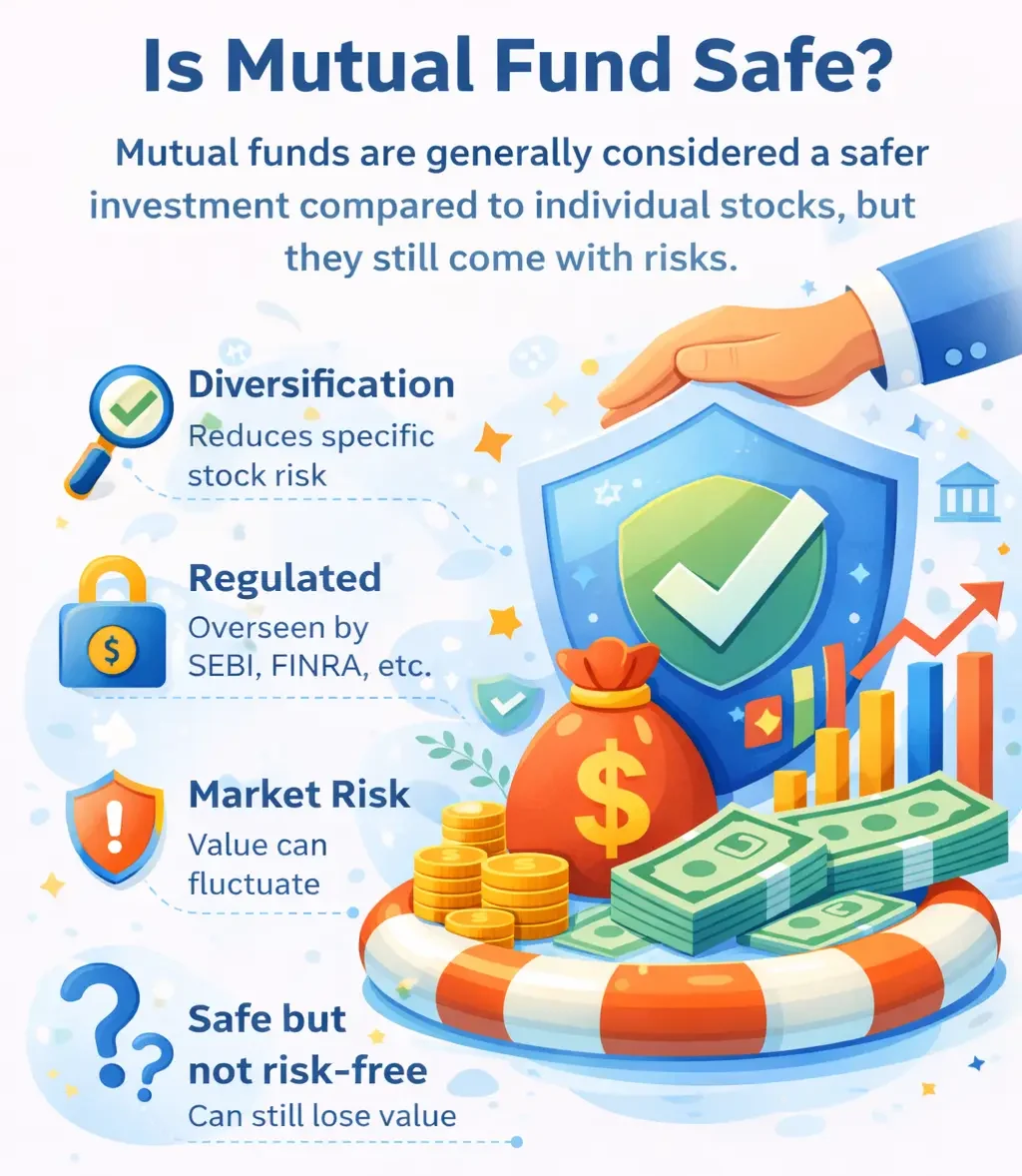
The short answer is: Mutual funds are generally safe when chosen wisely, but they are not risk-free.
This blog explains what “safety” really means in mutual funds, the risks involved, how mutual funds are regulated, and how investors can reduce risk while investing.
What Does “Safe” Mean in Investing?
Before deciding whether mutual funds are safe, it is important to understand what safety means in the context of investments.
In finance, safety does not mean guaranteed returns. Instead, it refers to:
- Protection from fraud
- Transparency in operations
- Regulation by authorities
- Risk spread across multiple assets
- Suitability for long-term wealth creation
What Is a Mutual Fund?
A mutual fund is an investment vehicle that collects money from multiple investors and invests it in a diversified portfolio of assets such as stocks, bonds, or money market instruments. These funds are managed by professional fund managers who follow a defined investment strategy.
Investors own units of the mutual fund, and the value of these units changes daily based on the performance of the underlying assets.
Every year you delay, your future self pays.
A ₹10,000 monthly SIP started today for 20 years can grow to a far larger corpus than the same SIP started 5 years later. Waiting costs you lakhs in lost compounding.
Are Mutual Funds Safe From Fraud?
Yes, mutual funds are considered safe from fraud because they are tightly regulated.
In India, mutual funds are regulated by SEBI (Securities and Exchange Board of India). SEBI enforces strict rules regarding:
- Fund management
- Disclosure of portfolio holdings
- NAV calculation
- Investor protection
- Audits and compliance
Types of Risks in Mutual Funds
To understand whether mutual funds are safe, it is essential to understand the risks involved.
- Market Risk: Equity mutual funds are affected by stock market movements. Short-term volatility can cause temporary losses, especially during market downturns.
- Credit Risk: Debt mutual funds may face risk if the issuer of a bond defaults on payments.
- Interest Rate Risk Changes in interest rates can impact the value of debt funds.
- Inflation Risk: If returns do not beat inflation, the real value of money may reduce over time.
Are All Mutual Funds Equally Safe?
No. Safety depends on the type of mutual fund.
Equity Mutual Funds
Higher risk in the short term
Suitable for long-term investors
Potential for higher returns
Not ideal for short-term safety
Debt Mutual Funds
Lower risk compared to equity funds
More stable returns
Suitable for conservative investors
Hybrid Mutual Funds
Balance between risk and stability
Combine equity and debt investments
Liquid and Money Market Funds
Considered among the safest mutual fund categories
Low volatility
Suitable for short-term parking of funds
How Diversification Improves Mutual Fund Safety
One of the biggest advantages of mutual funds is diversification.
Instead of investing in one company or bond, a mutual fund spreads investments across multiple securities. This reduces the impact of poor performance by any single asset.
Diversification helps:
Lower overall risk
Reduce volatility
Protect investors from major losses
Is SIP Safer Than Lump Sum Investment?
Many investors use SIP (Systematic Investment Plan) to reduce risk.
SIP does not remove market risk, but it helps manage it by:
- Spreading investments over time
- Reducing the impact of market timing
- Encouraging disciplined investing
Are Mutual Funds Safe for Beginners?
Yes, mutual funds are considered one of the safest entry points for beginners, provided:
- The right fund type is chosen
- Investments match financial goals
- Risk tolerance is understood
Beginners often benefit from:
- Professional fund management
- Small minimum investment amounts
- Transparent performance tracking
- Easy liquidity
Can You Lose Money in Mutual Funds?
Yes, it is possible to lose money in mutual funds, especially in the short term. However:
- Losses are usually temporary for long-term investors
- Risk reduces with time and diversification
- Proper fund selection significantly lowers risk
Mutual funds are not gambling instruments, they are structured investment tools designed for long-term wealth creation.
Final Verdict: Is Mutual Fund Safe?
So, is mutual fund safe?
The honest answer is: Yes, mutual funds are safe when used correctly, but they are not risk-free.
They are regulated, transparent, diversified, and professionally managed, making them one of the most reliable investment options available today. While short-term fluctuations are unavoidable, long-term investors who choose suitable funds and stay invested are generally well rewarded.
Mutual funds are not about eliminating risk, they are about managing risk smartly.
WELFIN INSIGHT
“The right insurance amount is not the cheapest or the highest it’s the one that fits your life.”
