

WHY WOULD SOMEONE CHOOSE A MUTUAL FUND OVER A STOCK?

WHY WOULD SOMEONE CHOOSE A MUTUAL FUND OVER A STOCK? Investing can often feel overwhelming, especially with the wide range of options available stocks, bonds, real estate, money market instruments, and more. While investing in individual stocks can help generate significant wealth, it also requires time, expertise, and the ability to tolerate risk. For many investors, choosing a mutual fund over a stock offers a more balanced and potentially safer way to participate in the market. Mutual funds provide professional management, diversification, and convenience, making them an attractive option for both beginners and seasoned investors. Let’s explore why many people prefer mutual funds over individual stocks. Mutual Fund Over a Stock: The Basics A mutual fund pools money from multiple investors and invests it across a diversified portfolio of securities such as stocks, bonds, money market instruments, or a combination of these. Each mutual fund is designed to meet a specific investment objective growth, income, stability, or a mix of all three. A professional fund manager oversees the investment decisions, allocating assets to generate returns aligned with the fund’s objective. This structured and managed approach makes mutual funds a preferred investment vehicle for many investors. Key Reasons to Choose a Mutual Fund Over a Stock 1. Diversification Reduces Risk Diversification is one of the most effective ways to manage investment risk. Investing in a single stock exposes you to company-specific risks, while mutual funds spread investments across multiple companies, sectors, and asset classes. Financial experts suggest that holding 20 or more stocks across different industries can significantly reduce unsystematic risk. However, building such a diversified stock portfolio can be expensive and complex for individual investors due to brokerage costs and capital requirements. A mutual fund allows investors to achieve instant diversification with a relatively small investment. By purchasing units of a single fund, investors gain exposure to dozens—sometimes hundreds—of securities across multiple sectors such as finance, technology, healthcare, and manufacturing. 2. Convenience and Simplicity Selecting individual stocks requires: Market research Company analysis Continuous tracking of performance Regular portfolio rebalancing For many investors, this process is time-consuming and intimidating. Mutual funds simplify investing by offering ready-made portfolios managed by professionals. Instead of analyzing multiple companies, investors can simply choose a fund that aligns with their goals and risk tolerance. This convenience makes mutual funds especially appealing to individuals with limited time or market knowledge. 3. Professional Management Mutual funds are managed by experienced professionals who: Track market trends Conduct in-depth research Make informed buy-and-sell decisions While professional management does not guarantee profits, it helps reduce emotional investing and improves decision-making discipline two common challenges faced by individual stock investors. 4. Variety of Investment Options Mutual funds cater to different investment objectives and risk appetites. Some popular types include: Sector Funds: Focus on specific industries like IT, healthcare, or banking Growth Funds: Invest in companies with high growth potential Value Funds: Target undervalued stocks for long-term gains Index Funds: Track market indices such as Nifty or Sensex Bond Funds: Generate regular income through fixed-income securities This variety allows investors to customize their portfolios without managing individual securities. 5. Lower Transaction Costs Frequent trading in individual stocks can result in high brokerage fees, which may significantly reduce overall returns especially for small investors. In mutual funds, transaction costs are shared among all investors, making them more cost-efficient. Many funds also offer: Low expense ratios Zero-transaction-fee purchases Systematic Investment Plans (SIPs) This makes mutual funds more accessible and economical over the long term. Things to Keep in Mind While mutual funds offer several advantages, they are not risk-free. Market fluctuations can affect fund performance, and management fees may impact returns. Therefore, it is important to: Understand the fund’s objective Review expense ratios Assess past performance (without relying solely on it) Most online brokerage platforms provide mutual fund screeners to help investors compare funds based on risk, returns, fees, and investment style including socially responsible or ESG-focused funds. Conclusion Choosing a mutual fund over a stock can be a smart decision for investors seeking diversification, professional management, convenience, and cost efficiency. While individual stocks may offer higher return potential, mutual funds provide a more structured and disciplined approach to wealth creation especially for those who prefer a hands-off investment strategy. As with any investment decision, educating yourself and aligning investments with your financial goals is key to long-term success. WELFIN INSIGHT “The right insurance amount is not the cheapest or the highest it’s the one that fits your life.” January 16, 2026 HOW CAN YOU INCREASE YOUR HEALTH INSURANCE COVERAGE? – Copy Read More January 16, 2026 Term insurance buying tips Read More January 16, 2026 Why financial planning is important for everyone? Read More Confused about money decisions? Get clarity on investments, insurance & goals in one plan. Check Now Not sure if your insurance is enough? 👉 Get a Free Insurance Adequacy Check Get In Touch
IMPORTANCE OF HEALTH INSURANCE IN 2026

IMPORTANCE OF HEALTH INSURANCE IN 2026 In 2026, the landscape of health insurance has shifted from being a “safety net” to becoming a proactive health management tool. With medical inflation in India currently hovering around 11.5% to 14%, a simple hospital stay can now significantly impact years of savings. Here is an updated perspective on why health insurance is no longer optional in 2026. 5 Reasons Why Health Insurance is Critical in 2026 1. Combating High Medical Inflation India currently faces some of the highest medical inflation rates in Asia. Treatments for cardiovascular diseases, cancer, and gastrointestinal conditions are the primary drivers of rising costs. Without a comprehensive health plan, the out-of-pocket expenses for advanced surgeries and specialty medications can be devastating for a middle-class family. 2. New IRDAI “Insurance for All” Regulations The regulatory environment has become much more consumer-friendly. Key updates you should know: No Age Bar: Insurers can no longer deny you a policy based on your age. Whether you are 25 or 75, you are entitled to coverage. Faster Cashless Approvals: New guidelines mandate that insurers must provide “Initial Authorization” for cashless claims within 1 hour and final discharge clearance within 3 hours. Reduced Waiting Periods: The maximum waiting period for pre-existing diseases (PED) has been reduced from 4 years to 3 years. 3. Rise of Lifestyle & Chronic Diseases Non-communicable diseases (NCDs) like hypertension, diabetes, and obesity-related heart conditions are affecting a younger demographic than ever before. Modern policies now include Wellness Benefits—rewarding you with premium discounts if you maintain a healthy step count or undergo regular preventive screenings. 4. Integration of “Modern Medicine” 2026 policies are much broader in scope. Most plans now include: AYUSH Coverage: Ayurveda, Yoga, Unani, Siddha, and Homeopathy are now covered up to the full sum insured with no sub-limits. Mental Health: Inpatient psychiatric treatment is now standard in most comprehensive plans. Home Care (Domiciliary): With the rise of “Hospital at Home” technology, many insurers cover professional medical care provided in the comfort of your house. 5. Tax Efficiency under Section 80D Under the Old Tax Regime, health insurance remains one of the best ways to lower your taxable income: Self & Family: Up to ₹25,000 (₹50,000 if you are a senior citizen). Parents: An additional ₹25,000 (₹50,000 if they are senior citizens). Total Benefit: You can claim a total deduction of up to ₹1,00,000 annually if both you and your parents are over 60. Buying Tips for 2026 Check the “Moratorium Period”: In 2026, this has been reduced to 5 years. After 5 years of continuous coverage, an insurer cannot reject your claim based on non-disclosure of old medical history (except in cases of proven fraud). Opt for “Restore” or “Refill” Benefits: Ensure your policy automatically restores your sum insured if you exhaust it during a single year. This is vital for family floater plans. Prioritize Cashless Networks: With the IRDAI’s “Cashless Everywhere” initiative, ensure your agency helps you navigate hospitals that offer 100% cashless settlements. Conclusion The shift from reactive to proactive healthcare is the hallmark of 2026. Modern insurance doesn’t just pay your hospital bills; it provides for your annual check-ups, pharmacy discounts, and teleconsultations. Investing early ensures you lock in lower premiums and complete your waiting periods while you are still healthy. WELFIN INSIGHT “The right insurance amount is not the cheapest or the highest it’s the one that fits your life.” January 16, 2026 IMPORTANCE OF HEALTH INSURANCE IN 2026 Read More January 16, 2026 Is it a good idea to invest in LIC stocks? Read More January 16, 2026 5 Common Financial Mistakes Salaried People Should Avoid Read More Confused about money decisions? Get clarity on investments, insurance & goals in one plan. Check Now Not sure if your insurance is enough? 👉 Get a Free Insurance Adequacy Check Get In Touch
Is it a good idea to invest in LIC stocks?

Is it a good idea to invest in LIC stocks in 2026? Welfin Best Financial advisor in Kolkata For most salaried employees in India, the monthly “Salary Credited” notification is a moment of brief joy. However, for many, that joy is quickly replaced by the stress of EMIs, utility bills, and the dreaded “month-end crunch.” But why does this cycle persist even as your income grows? The problem usually isn’t the size of your paycheck; it is the hidden leaks in your financial bucket. A recent study by Finology paints a worrying picture: one in four salaried individuals cannot survive even a single month if they lose their job. We are earning more, but we are living more dangerously. To turn your paycheck into a path toward freedom, you must avoid these five common financial pitfalls that trap the modern salaried class. 1. Living Without a Safety Net (The “One Paycheck” Risk) The biggest mistake is Optimism Bias the belief that your monthly salary is a permanent guarantee. This false sense of security leads to a lifestyle where income exactly equals expenditure, leaving zero room for error. According to a survey of over 3 lakh millennials, 75% of Indians do not have an emergency fund. This means the majority of the workforce is operating without a financial shock absorber. A mere 30-day delay in salary could force a significant portion of the salaried class into immediate distress. When you don’t have liquid cash during a crisis, you are forced to raid your future. The study shows that 57% of people would have to sell long-term investments (like breaking FDs or stopping SIPs) just to pay their EMIs if their income stopped. Worse, 15% said they would simply have to skip EMI payments, permanently damaging their credit scores. 2. Funding “Lifestyle” Instead of Assets (The Debt Trap) Our parents mostly borrowed to build assets like constructing a home. Today, the trend has flipped. We are increasingly borrowing to fund a lifestyle we cannot yet afford. Recent data shows that 55% of total household debt in India is now for “non-housing retail loans.” This means borrowed money is being spent on depreciating items like cars, gadgets, and vacations. This “Instant Gratification” culture is fueling a fire: credit card spending has surged 13x over the last 13 years. Using “Buy Now, Pay Later” schemes for luxuries effectively mortgages your future income, forcing you to pay interest on past expenses instead of earning interest on your surplus. 3. The “Mañana” Syndrome: Delaying Retirement Planning “I am too young to think about retirement” is the most expensive sentence in personal finance. The math of compounding is brutal for those who wait. Data shows that 93% of people above age 50 regret delaying their retirement planning. There is also a massive reality gap: while 55% of people expect a monthly pension of over ₹1 Lakh, only 11% are confident their current savings can deliver that. Many rely on corporate gratuity as a safety net, yet 99% of people eventually find that gratuity is woefully insufficient to cover actual retirement needs. 4. Being “Risk Averse” to the Point of Real Loss Salaried people often confuse “safe” investments with “smart” ones. Fear of market volatility leads many to keep their entire corpus in savings accounts or traditional low-yield policies. According to SEBI, 80% of Indian households still prefer this “capital preservation” approach. The problem? “Safe” money is silently losing value to inflation. With edible oil prices up by 17.4% and fruits by 13.8%, money sitting in a savings account at 3% interest is shrinking in purchasing power. By trying to avoid the “risk” of the market, you are guaranteeing the loss of value to inflation. 5. Confusing “Employer Insurance” with “Real Protection” A common blind spot is over-reliance on company benefits. Many believe their Group Health Insurance is sufficient, ignoring that this cover vanishes the day they leave or retire. This creates a dangerous “protection gap.” Currently, 82% of life insurance holders lack adequate coverage to replace their income for their families. Furthermore, 69% lack critical illness cover, meaning a single major diagnosis like cancer or heart disease could wipe out years of savings because a standard corporate policy isn’t designed for such high-cost events. The Solution: Implement the 70-10-10-10 Rule Identifying mistakes is easy; fixing them requires a behavioral guardrail. Instead of eating the “income pie” randomly, slice it the moment your salary hits: 70% for Living Expenses: Covers both Needs (Rent, EMI, Groceries) and Wants (Travel, Dining). If your expenses exceed 70%, you are living beyond your means and must cut lifestyle costs, not savings. 10% for Retirement: This is non-negotiable. Move this to an NPS, PPF, or equity fund immediately. Don’t be part of the 93% who regret waiting. 10% for Emergency & Debt: Use this to build your 6-month buffer or aggressively pay off high-interest credit cards. 10% for Wealth & Growth: Invest this in high-growth assets or upskilling. This is the money that builds your “rich” life, while the other buckets keep you “safe.” Conclusion Wealth isn’t just about how much you earn; it is about how few mistakes you make. If you can plug these five leaks, your financial future will stabilize itself. The market will always fluctuate, but your discipline is the only variable you can truly control. WELFIN INSIGHT “The right insurance amount is not the cheapest or the highest it’s the one that fits your life.” January 16, 2026 HOW CAN YOU INCREASE YOUR HEALTH INSURANCE COVERAGE? Read More January 16, 2026 IMPORTANCE OF HEALTH INSURANCE IN 2026 Read More January 16, 2026 Is it a good idea to invest in LIC stocks? Read More Confused about money decisions? Get clarity on investments, insurance & goals in one plan. Check Now Not sure if your insurance is enough? 👉 Get a Free Insurance Adequacy Check Get In Touch
5 Common Financial Mistakes Salaried People Should Avoid
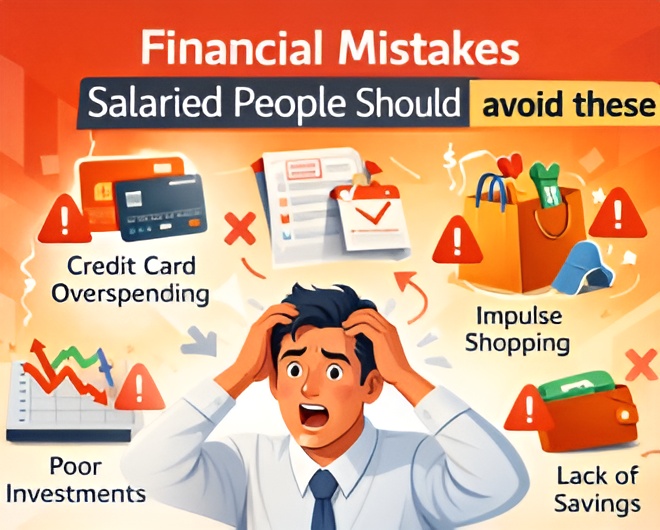
5 Common Financial Mistakes Salaried People Should Avoid For most salaried employees in India, the monthly “Salary Credited” notification is a moment of brief joy. However, for many, that joy is quickly replaced by the stress of EMIs, utility bills, and the dreaded “month-end crunch.” But why does this cycle persist even as your income grows? The problem usually isn’t the size of your paycheck; it is the hidden leaks in your financial bucket. A recent study by Finology paints a worrying picture: one in four salaried individuals cannot survive even a single month if they lose their job. We are earning more, but we are living more dangerously. To turn your paycheck into a path toward freedom, you must avoid these five common financial pitfalls that trap the modern salaried class. 1. Living Without a Safety Net (The “One Paycheck” Risk) The biggest mistake is Optimism Bias the belief that your monthly salary is a permanent guarantee. This false sense of security leads to a lifestyle where income exactly equals expenditure, leaving zero room for error. According to a survey of over 3 lakh millennials, 75% of Indians do not have an emergency fund. This means the majority of the workforce is operating without a financial shock absorber. A mere 30-day delay in salary could force a significant portion of the salaried class into immediate distress. When you don’t have liquid cash during a crisis, you are forced to raid your future. The study shows that 57% of people would have to sell long-term investments (like breaking FDs or stopping SIPs) just to pay their EMIs if their income stopped. Worse, 15% said they would simply have to skip EMI payments, permanently damaging their credit scores. 2. Funding “Lifestyle” Instead of Assets (The Debt Trap) Our parents mostly borrowed to build assets like constructing a home. Today, the trend has flipped. We are increasingly borrowing to fund a lifestyle we cannot yet afford. Recent data shows that 55% of total household debt in India is now for “non-housing retail loans.” This means borrowed money is being spent on depreciating items like cars, gadgets, and vacations. This “Instant Gratification” culture is fueling a fire: credit card spending has surged 13x over the last 13 years. Using “Buy Now, Pay Later” schemes for luxuries effectively mortgages your future income, forcing you to pay interest on past expenses instead of earning interest on your surplus. 3. The “Mañana” Syndrome: Delaying Retirement Planning “I am too young to think about retirement” is the most expensive sentence in personal finance. The math of compounding is brutal for those who wait. Data shows that 93% of people above age 50 regret delaying their retirement planning. There is also a massive reality gap: while 55% of people expect a monthly pension of over ₹1 Lakh, only 11% are confident their current savings can deliver that. Many rely on corporate gratuity as a safety net, yet 99% of people eventually find that gratuity is woefully insufficient to cover actual retirement needs. 4. Being “Risk Averse” to the Point of Real Loss Salaried people often confuse “safe” investments with “smart” ones. Fear of market volatility leads many to keep their entire corpus in savings accounts or traditional low-yield policies. According to SEBI, 80% of Indian households still prefer this “capital preservation” approach. The problem? “Safe” money is silently losing value to inflation. With edible oil prices up by 17.4% and fruits by 13.8%, money sitting in a savings account at 3% interest is shrinking in purchasing power. By trying to avoid the “risk” of the market, you are guaranteeing the loss of value to inflation. 5. Confusing “Employer Insurance” with “Real Protection” A common blind spot is over-reliance on company benefits. Many believe their Group Health Insurance is sufficient, ignoring that this cover vanishes the day they leave or retire. This creates a dangerous “protection gap.” Currently, 82% of life insurance holders lack adequate coverage to replace their income for their families. Furthermore, 69% lack critical illness cover, meaning a single major diagnosis like cancer or heart disease could wipe out years of savings because a standard corporate policy isn’t designed for such high-cost events. The Solution: Implement the 70-10-10-10 Rule Identifying mistakes is easy; fixing them requires a behavioral guardrail. Instead of eating the “income pie” randomly, slice it the moment your salary hits: 70% for Living Expenses: Covers both Needs (Rent, EMI, Groceries) and Wants (Travel, Dining). If your expenses exceed 70%, you are living beyond your means and must cut lifestyle costs, not savings. 10% for Retirement: This is non-negotiable. Move this to an NPS, PPF, or equity fund immediately. Don’t be part of the 93% who regret waiting. 10% for Emergency & Debt: Use this to build your 6-month buffer or aggressively pay off high-interest credit cards. 10% for Wealth & Growth: Invest this in high-growth assets or upskilling. This is the money that builds your “rich” life, while the other buckets keep you “safe.” Conclusion Wealth isn’t just about how much you earn; it is about how few mistakes you make. If you can plug these five leaks, your financial future will stabilize itself. The market will always fluctuate, but your discipline is the only variable you can truly control. WELFIN INSIGHT “The right insurance amount is not the cheapest or the highest it’s the one that fits your life.” January 16, 2026 5 Common Financial Mistakes Salaried People Should Avoid Read More January 16, 2026 What are the Tax Benefits Associated with Loan against property? Read More January 16, 2026 Guide to Financial Planning for Salaried Employees Read More Confused about money decisions? Get clarity on investments, insurance & goals in one plan. Check Now Not sure if your insurance is enough? 👉 Get a Free Insurance Adequacy Check Get In Touch
What are the Tax Benefits Associated with Loan against property?

What are the Tax Benefits Associated with Loan against property? Owning a home is a dream for many, but leveraging that property to get a loan can also be a smart financial move. While a Loan Against Property (LAP) is often used for personal or business needs, the tax benefits are not as automatic as they are with a traditional Home Loan. Under the current Income Tax Act (as of 2026), the tax benefits on a LAP depend entirely on the end-use of the funds. Here is an updated look at how you can save on taxes with a Loan Against Property. 1. Business Purpose: Section 37(1) If you are a business owner or a self-employed professional and you use the loan amount for business expansion, working capital, or other operational expenses, you can claim significant benefits. What is deductible: You can claim the entire interest paid, along with processing fees and documentation charges, as a business expense. The Benefit: These expenses are deducted from your total business turnover, reducing your taxable “Profits and Gains from Business or Profession.” Condition: You must maintain clear documentation (invoices, bank statements) to prove the funds were used exclusively for business. 2. Residential Property: Section 24(b) Even though it is a “Loan Against Property,” if you use the borrowed money to fund the purchase, construction, or renovation of another residential property, you can claim interest deductions. Self-Occupied Property: You can deduct up to ₹2 Lakh of the interest paid per year. Let-Out (Rental) Property: There is no upper limit on the interest deduction for a rented property. Renovation/Repairs: If the funds are used specifically for repairs or renovation of your existing home, the deduction is capped at ₹30,000 (within the overall ₹2 Lakh limit of Section 24). 3. The “New Tax Regime” Note (2026 Update) The Indian tax landscape has shifted significantly toward the New Tax Regime. Old Regime: You can still claim all deductions mentioned above (Section 24b, etc.). New Regime: Most deductions, including interest on self-occupied property, are not available. However, interest on let-out (rented) property can still be claimed against the rental income, even under the new regime. Key Differences: LAP vs. Home Loan It is important to note where a Loan Against Property does not provide benefits compared to a standard Home Loan: Feature Home Loan Loan Against Property (LAP) Section 80C (Principal) Deductible up to ₹1.5 Lakh. No deduction on principal repayment. Section 24(b) (Interest) Always deductible for housing. Deductible only if used for a new house. Stamp Duty/Reg. Fees Deductible under 80C. Not deductible for the mortgaged property. When are NO Tax Benefits allowed? You cannot claim any tax exemptions if the loan amount is used for: Personal Expenses: Weddings, vacations, or household furniture. Medical Emergencies: Hospital bills or treatments. Education: While there is a separate Section 80E for education loans, using a LAP for tuition does not qualify for that specific deduction. Pro-Tip for 2026: Always obtain an Interest Certificate from your lender at the end of the financial year. To satisfy an income tax audit, you must show a direct “trail” of money from the loan disbursement to the final payment for your business or new home. WELFIN INSIGHT “The right insurance amount is not the cheapest or the highest it’s the one that fits your life.” January 16, 2026 5 Common Financial Mistakes Salaried People Should Avoid Read More January 16, 2026 What are the Tax Benefits Associated with Loan against property? Read More January 16, 2026 Guide to Financial Planning for Salaried Employees Read More Confused about money decisions? Get clarity on investments, insurance & goals in one plan. Check Now Not sure if your insurance is enough? 👉 Get a Free Insurance Adequacy Check Get In Touch
Guide to Financial Planning for Salaried Employees
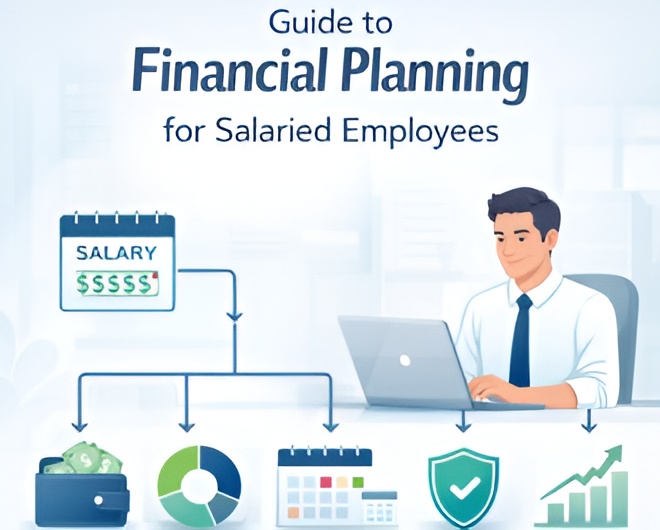
8 Step Smart Financial Planning for Buying Your First House Buying your first home is a complex puzzle where the “sticker price” is only the first piece. To ensure your home is a wealth-building asset and not a debt trap, you need a high-resolution financial strategy. Here is the 8-step master plan to navigate the financial landscape of buying your first home. 1. Step 1: The “Audit” – Establishing Your Real Affordability Before looking at properties, look at your net cash flow. Banks use a Fixed Obligation to Income Ratio (FOIR) to decide your eligibility, and you should use a stricter one for your peace of mind. The 30% Hard Ceiling: Your monthly EMI should never exceed 30% of your net take-home pay. If you earn ₹1.5 Lakh, your EMI must stay under ₹45,000. CIBIL Health Check: In 2026, lenders offer “risk-based pricing.” A score of 750-800+ can get you an interest rate that is 0.50% lower than someone with a score of 700. Over 20 years, this 0.5% difference can save you ₹10–15 Lakh. Existing Debt Clearance: Close small liabilities like car loans or credit card EMIs at least 6 months before applying. This “cleans” your debt-to-income ratio, allowing for a higher home loan limit. Step 2: Factoring in the “Transaction Delta” (Hidden Costs) A common mistake is saving only for the 20% down payment. In the Indian market, the “Agreement Value” is far from the “Final Cost.” Statutory Charges: Budget 5–7% for Stamp Duty and 1% for Registration (varying by state). The GST Factor: If the property is under-construction, add 5% GST (1% for affordable housing). Ready-to-move-in homes are GST-exempt. Ancillary Costs: Factor in 1–2% for Brokerage (if applicable) and ₹50,000–₹1,00,000 for legal due diligence and processing fees. Step 3: The “Aggressive” Down Payment Model While banks fund 80%, smart buyers aim for 25–35%. Why? A higher down payment reduces your “Loan-to-Value” (LTV) ratio, which can qualify you for the bank’s most competitive interest rates. The Savings Mix: If your purchase is 2+ years away, use a mix of Arbitrage Funds and Short-Term Debt Funds. If it’s less than 12 months away, stick to Liquid Funds or High-Yield FDs to protect the principal. Step 4: Securing a Pre-Approved “Financial Passport” Don’t shop for a house without a bank’s letter of intent. Bargaining Power: Having a pre-approval letter tells the developer you are a “confirmed buyer,” giving you the upper hand to negotiate a lower base price or freebies like covered parking. Boundary Setting: It prevents “budget creep”—the tendency to look at a slightly more expensive house and convince yourself you can “somehow” manage the extra EMI. Step 5: The “20-Year” Repayment Logic Lenders will push for a 30-year tenure to make the EMI look smaller. Do not fall for this. Total Interest Outgo: On a 30-year loan, you often end up paying back nearly 2.5 times the principal amount. The Sweet Spot: Stick to a 15 to 20-year tenure. The 5% Strategy: Commit to increasing your EMI by 5% every year as your salary grows. This simple hack can finish a 20-year loan in just 12 years, saving you decades of interest. Step 6: Interior Budgeting (The “Bare Shell” Trap) Possession day is not moving day. A new apartment requires significant capital to become a “home.” Standard Estimates: Budget roughly ₹1,000 to ₹1,500 per sq. ft. for basic functional interiors (modular kitchen, wardrobes, lighting, and fans). Liquidity Rule: Ensure you have this amount in cash/liquid savings. Taking a “Top-up Loan” or “Personal Loan” for interiors right after a home loan puts extreme stress on your monthly cash flow. Step 7: The “Insurance Moat” Strategy A home loan is a 20-year liability that your family should not inherit. Avoid Bank HLPPs: Banks often bundle “Home Loan Protection Plans” (HLPP) where the premium is added to the loan. These are expensive and the cover reduces as you pay off the loan. The Term Plan Alternative: Buy an independent Term Insurance policy for the loan amount. It’s cheaper, the cover remains constant, and it stays with you even if you switch your loan to another bank. Step 8: The “Possession Buffer” & Emergency Fund Your financial planning doesn’t end when you get the keys. The Sinking Fund: Societies often ask for a 1–2 year advance maintenance deposit and a one-time “Corpus Fund” payment during possession. This can range from ₹1 Lakh to ₹3 Lakh. The Reset Fund: After buying a home, your Emergency Fund must be recalibrated. It should now cover 6 months of your new expenses, including the home loan EMI, property taxes, and society maintenance. Conclusion: Foundations First The goal of smart home buying is to ensure that the roof over your head doesn’t become a weight on your shoulders. By following these eight steps, you move from being an “aspiring buyer” to a “strategic owner.” WELFIN INSIGHT “The right insurance amount is not the cheapest or the highest it’s the one that fits your life.” January 16, 2026 What are the Tax Benefits Associated with Loan against property? Read More January 16, 2026 Guide to Financial Planning for Salaried Employees Read More January 16, 2026 WHAT ARE THE DIFFERENCES BETWEEN 1ST PARTY INSURANCE AND 3RD PARTY INSURANCE: MOTOR INSURANCE BUYING TIPS Read More Confused about money decisions? Get clarity on investments, insurance & goals in one plan. Check Now Not sure if your insurance is enough? 👉 Get a Free Insurance Adequacy Check Get In Touch
WHAT ARE THE DIFFERENCES BETWEEN 1ST PARTY INSURANCE AND 3RD PARTY INSURANCE: MOTOR INSURANCE BUYING TIPS

WHAT ARE THE DIFFERENCES BETWEEN 1ST PARTY INSURANCE AND 3RD PARTY INSURANCE: MOTOR INSURANCE BUYING TIPS Navigating motor insurance in 2026 requires more than just knowing the law. With the surge in Electric Vehicles (EVs), AI-driven premium pricing, and paperless claims, understanding the difference between First-Party and Third-Party coverage is essential to protect your investment Is Motor Insurance Still Mandatory? Yes. Under Section 146 of the Motor Vehicles Act, it remains illegal to drive any vehicle in a public space without at least Third-Party (TP) insurance.1 While TP is the legal minimum, the IRDAI (Insurance Regulatory and Development Authority of India) now encourages “Bundled Policies” for new vehicles—typically 3 years of TP and 1 year of Own Damage (OD) for cars. 1st Party vs. 3rd Party: The Key Differences Feature First-Party (Own Damage/Comprehensive) Third-Party (Liability Only) Who is covered? You (the owner) and your vehicle. The “other” person (victim) and their property. Legal Status Optional (but highly recommended). Mandatory by law. Coverage Scope Theft, accidents, fire, natural disasters, and EV battery damage. Legal liability for injury, death, or property damage to others. Premium Cost Higher (based on vehicle value/IDV). Lower (fixed by IRDAI based on engine/motor capacity). No Claim Bonus You earn discounts for every claim-free year. Not applicable. 2026 Motor Insurance Buying Tips The insurance landscape has evolved. Here is how to buy smart this year: 1. Account for Technology & EVs If you drive an Electric Vehicle or a Hybrid, a standard policy isn’t enough. Battery Protection Add-on: In 2026, EV batteries make up nearly 40% of a car’s value. Ensure you have a specific cover for battery damage or short circuits. Smart Key Protection: Replacing high-tech sensor keys can now cost upwards of ₹15,000. This add-on is a lifesaver. 2. Understand Your IDV (Insured Declared Value) Your IDV is the maximum sum the insurer will pay if your car is stolen or totaled.2 Tip: Don’t intentionally lower your IDV to save on premiums.3 In the event of a total loss, you will receive significantly less than the car’s market value. 3. Look for “Pay-As-You-Drive” Models Many insurers now offer usage-based insurance (UBI).4 If you work from home or use your car infrequently, you can opt for a “Pay-As-You-Drive” policy, which can reduce your 1st-party premium by up to 25%. 4. Zero Depreciation is a Must For vehicles under 5 years old, a Zero-Dep (Nil Depreciation) cover ensures the insurer pays the full cost of replacement parts (like plastic, fiber, or rubber) without deducting for wear and tear.5 Filing Claims in the Digital Era First-Party Claims (Your Damage) In 2026, most claims are “Video-First.” Instant Notification: Use the insurer’s app to upload a 360-degree video of the accident spot. AI Assessment: Many companies now use AI to estimate repair costs within minutes of your upload. Cashless Garages: Stick to the insurer’s authorized network to ensure the bill is settled directly between the workshop and the company. Third-Party Claims (Damage to Others) Third-party claims still involve the MACT (Motor Accident Claims Tribunal).6 Limit: Property damage is usually capped at ₹7.5 Lakh, while compensation for bodily injury or death is determined by the court based on the victim’s age and income.7 The Burden: If you only have TP insurance and your car is damaged, you must pay for your own repairs out of pocket.8 Final Verdict: Which should you choose? While Third-Party insurance keeps you on the right side of the law, it leaves you financially vulnerable. For 2026, especially with the high cost of vehicle repairs and electronics, a Comprehensive (First-Party) policy with Battery/Engine Protection and Zero-Depreciation is the gold standard for peace of mind. WELFIN INSIGHT “The right insurance amount is not the cheapest or the highest it’s the one that fits your life.” January 16, 2026 WHAT ARE THE DIFFERENCES BETWEEN 1ST PARTY INSURANCE AND 3RD PARTY INSURANCE: MOTOR INSURANCE BUYING TIPS Read More January 16, 2026 8 Step Smart Financial Planning for Buying Your First House – Copy Read More January 16, 2026 Karma Capital Advisors Private Limited as Portfolio Management Services Read More Confused about money decisions? Get clarity on investments, insurance & goals in one plan. Check Now Not sure if your insurance is enough? 👉 Get a Free Insurance Adequacy Check Get In Touch
Karma Capital Advisors Private Limited as Portfolio Management Services

Karma Capital Advisors Private Limited as Portfolio Management Services Portfolio Management Services (PMS) are professionally managed, customized investment solutions designed to meet the specific financial goals of select investors. These services primarily cater to High Net Worth Individuals (HNIs) and institutional investors who seek personalized strategies and superior long-term returns. Welcon Financials Pvt. Ltd. continuously strives to offer premium investment products and services to discerning investors. Our association with Karma Capital Advisors Private Limited strengthens our HNI desk by delivering highly specialized and performance-driven portfolio management solutions to clients seeking consistent and exceptional outcomes. About Karma Capital Advisors Private Limited Karma Capital Advisors Private Limited was founded in 2005 by Nikhil Desai and Rushabh Sheth, two well-recognized leaders in the investment management space. The firm is a SEBI-registered Investment and Management Advisory with a strong institutional pedigree. Since inception, Karma Capital has grown significantly, managing an Assets Under Management (AUM) of ₹4,585.64 crore with a focused client base of around 40 institutional and high-net-worth clients. Notable relationships include: Murugappa Family Group Fund Volvo Motors Pension Fund Danske – Denmark Government Pension Fund Norges Bank – Sovereign Wealth Fund of Norway This strong institutional backing reflects the firm’s disciplined investment approach and robust risk management framework. Portfolio Management Services Offered The objective of Karma Capital’s Portfolio Management Services is to maximize returns while managing risk according to each investor’s risk appetite. PMS offerings are highly customized and include: Identification of suitable assets aligned with investor goals Development of a comprehensive investment policy Portfolio construction based on risk-return expectations Continuous portfolio monitoring and review Risk diversification across sectors and market capitalizations Types of Services Discretionary Portfolio Management ServicesTailored portfolios managed independently based on client objectives and risk tolerance. Advisory Portfolio Management ServicesExpert recommendations and insights to help investors make informed investment decisions. Investment Philosophy Karma Capital follows a disciplined, research-driven investment philosophy focused on long-term wealth creation. Key Principles Bottom-Up Stock Selection for sustainable growth Margin of Safety to protect downside risk Risk-Conscious Investing Process-Driven Decision Making Long-Term Capital Preservation and Growth Sectoral Exposure & Portfolio Allocation Karma Capital operates a Multi-Cap Portfolio Advisory, allowing flexibility across market capitalizations to capture growth opportunities while managing volatility. Portfolio Construction & Concentration Portfolio Top 5 Holdings Top 10 Holdings Karma Wealth Builder 43.20% 69.10% This level of concentration reflects high conviction investing without excessive diversification that may dilute returns. Calendar Year Returns – Karma Wealth Builder Year Returns (%) 2011 -33.6 2012 63 2013 -10 2014 63.4 2015 19.4 2016 12.4 2017 60.2 2018 -24.5 2019 -10.8 2020 21.8 2021 (YTD) 59.6 Past performance is not indicative of future results. Fee Structure Karma Capital Advisors Private Limited offers one of the most competitive fee structures in the PMS industry. Fees are performance-linked, ensuring alignment of interests between the portfolio manager and investors. Typically, profits are shared at a rate of 20%, creating a win-win outcome. Risk Management Framework Risk management is a core strength of Karma Capital. Their proactive approach focuses on: Diversification across sectors and market caps Continuous assessment of portfolio risk Dynamic reallocation based on performance and market conditions Tax-efficient investment planning Effective portfolio risk management enhances long-term value creation and improves consistency in performance. Why Choose Karma Capital Advisors PMS Through Welcon Financials? High-conviction portfolios with disciplined diversification Proven track record of over 14 years Strong institutional research capabilities Multi-cap exposure for superior risk-adjusted returns Transparent operations and investor-friendly reporting Competitive and performance-linked fee structure Strict adherence to margin-of-safety principles Conflict-of-interest-free investment approach Karma Capital believes in identifying quality businesses and holding them through full growth cycles, allowing investors to benefit from long-term compounding. Conclusion Karma Capital Advisors Private Limited, in association with Welcon Financials Pvt. Ltd., offers a robust and transparent Portfolio Management Services platform designed for investors with significant capital and limited time. With a disciplined investment philosophy, strong risk controls, and an institutional-grade research framework, this PMS solution is well-suited for investors seeking long-term wealth creation with professional oversight. WELFIN INSIGHT “The right insurance amount is not the cheapest or the highest it’s the one that fits your life.” January 16, 2026 Karma Capital Advisors Private Limited as Portfolio Management Services Read More January 16, 2026 8 Step Smart Financial Planning for Buying Your First House Read More January 16, 2026 Things to remember before filing your Income Tax Read More Confused about money decisions? Get clarity on investments, insurance & goals in one plan. Check Now Not sure if your insurance is enough? 👉 Get a Free Insurance Adequacy Check Get In Touch
8 Step Smart Financial Planning for Buying Your First House

8 Step Smart Financial Planning for Buying Your First House Buying your first home is a complex puzzle where the “sticker price” is only the first piece. To ensure your home is a wealth-building asset and not a debt trap, you need a high-resolution financial strategy. Here is the 8-step master plan to navigate the financial landscape of buying your first home. 1. Step 1: The “Audit” – Establishing Your Real Affordability Before looking at properties, look at your net cash flow. Banks use a Fixed Obligation to Income Ratio (FOIR) to decide your eligibility, and you should use a stricter one for your peace of mind. The 30% Hard Ceiling: Your monthly EMI should never exceed 30% of your net take-home pay. If you earn ₹1.5 Lakh, your EMI must stay under ₹45,000. CIBIL Health Check: In 2026, lenders offer “risk-based pricing.” A score of 750-800+ can get you an interest rate that is 0.50% lower than someone with a score of 700. Over 20 years, this 0.5% difference can save you ₹10–15 Lakh. Existing Debt Clearance: Close small liabilities like car loans or credit card EMIs at least 6 months before applying. This “cleans” your debt-to-income ratio, allowing for a higher home loan limit. Step 2: Factoring in the “Transaction Delta” (Hidden Costs) A common mistake is saving only for the 20% down payment. In the Indian market, the “Agreement Value” is far from the “Final Cost.” Statutory Charges: Budget 5–7% for Stamp Duty and 1% for Registration (varying by state). The GST Factor: If the property is under-construction, add 5% GST (1% for affordable housing). Ready-to-move-in homes are GST-exempt. Ancillary Costs: Factor in 1–2% for Brokerage (if applicable) and ₹50,000–₹1,00,000 for legal due diligence and processing fees. Step 3: The “Aggressive” Down Payment Model While banks fund 80%, smart buyers aim for 25–35%. Why? A higher down payment reduces your “Loan-to-Value” (LTV) ratio, which can qualify you for the bank’s most competitive interest rates. The Savings Mix: If your purchase is 2+ years away, use a mix of Arbitrage Funds and Short-Term Debt Funds. If it’s less than 12 months away, stick to Liquid Funds or High-Yield FDs to protect the principal. Step 4: Securing a Pre-Approved “Financial Passport” Don’t shop for a house without a bank’s letter of intent. Bargaining Power: Having a pre-approval letter tells the developer you are a “confirmed buyer,” giving you the upper hand to negotiate a lower base price or freebies like covered parking. Boundary Setting: It prevents “budget creep”—the tendency to look at a slightly more expensive house and convince yourself you can “somehow” manage the extra EMI. Step 5: The “20-Year” Repayment Logic Lenders will push for a 30-year tenure to make the EMI look smaller. Do not fall for this. Total Interest Outgo: On a 30-year loan, you often end up paying back nearly 2.5 times the principal amount. The Sweet Spot: Stick to a 15 to 20-year tenure. The 5% Strategy: Commit to increasing your EMI by 5% every year as your salary grows. This simple hack can finish a 20-year loan in just 12 years, saving you decades of interest. Step 6: Interior Budgeting (The “Bare Shell” Trap) Possession day is not moving day. A new apartment requires significant capital to become a “home.” Standard Estimates: Budget roughly ₹1,000 to ₹1,500 per sq. ft. for basic functional interiors (modular kitchen, wardrobes, lighting, and fans). Liquidity Rule: Ensure you have this amount in cash/liquid savings. Taking a “Top-up Loan” or “Personal Loan” for interiors right after a home loan puts extreme stress on your monthly cash flow. Step 7: The “Insurance Moat” Strategy A home loan is a 20-year liability that your family should not inherit. Avoid Bank HLPPs: Banks often bundle “Home Loan Protection Plans” (HLPP) where the premium is added to the loan. These are expensive and the cover reduces as you pay off the loan. The Term Plan Alternative: Buy an independent Term Insurance policy for the loan amount. It’s cheaper, the cover remains constant, and it stays with you even if you switch your loan to another bank. Step 8: The “Possession Buffer” & Emergency Fund Your financial planning doesn’t end when you get the keys. The Sinking Fund: Societies often ask for a 1–2 year advance maintenance deposit and a one-time “Corpus Fund” payment during possession. This can range from ₹1 Lakh to ₹3 Lakh. The Reset Fund: After buying a home, your Emergency Fund must be recalibrated. It should now cover 6 months of your new expenses, including the home loan EMI, property taxes, and society maintenance. Conclusion: Foundations First The goal of smart home buying is to ensure that the roof over your head doesn’t become a weight on your shoulders. By following these eight steps, you move from being an “aspiring buyer” to a “strategic owner.” WELFIN INSIGHT “The right insurance amount is not the cheapest or the highest it’s the one that fits your life.” January 16, 2026 WHAT ARE THE DIFFERENCES BETWEEN 1ST PARTY INSURANCE AND 3RD PARTY INSURANCE: MOTOR INSURANCE BUYING TIPS Read More January 16, 2026 Karma Capital Advisors Private Limited as Portfolio Management Services Read More January 16, 2026 8 Step Smart Financial Planning for Buying Your First House Read More Confused about money decisions? Get clarity on investments, insurance & goals in one plan. Check Now Not sure if your insurance is enough? 👉 Get a Free Insurance Adequacy Check Get In Touch
Things to remember before filing your Income Tax

Things to remember before filing your Income Tax Income tax filing is the process through which an individual declares their income to the government and pays the applicable taxes. Similar to receiving final clearance from an employer or educational institution, filing your Income Tax Return (ITR) ensures compliance with tax laws. In India, any individual whose taxable income exceeds ₹2.5 lakh in a financial year is required to file an ITR. Before filing, it is essential to clearly understand the different heads of income under which your earnings fall. These may include salary, house property income, business or professional income, capital gains, and income from other sources. Proper planning and awareness can help you file your ITR accurately and avoid penalties. Below are the key points to remember before filing your income tax return. Key Things to Remember Before Filing Your Income Tax 1. Select the Correct ITR Form Choosing the correct ITR form is crucial for accurate filing. The applicable form depends on your residential status and sources of income. ITR-1 (Sahaj): For resident individuals with income up to ₹50 lakh from salary, one house property, and other sources. ITR-2: For individuals/HUFs with capital gains or foreign income. ITR-3 & ITR-4: For business or professional income. Using an incorrect form can lead to rejection or delays in processing your return. 2. Verify Pre-Filled ITR Information The Income Tax Department now provides pre-filled ITR forms using data from Form 26AS, AIS, and TIS, which include: Salary income Interest and dividend income Capital gains Personal details While this simplifies filing, taxpayers must verify all pre-filled data carefully. If you find any discrepancies, contact the respective bank, employer, or income payer to correct the details in their TDS filings. 3. Cross-Check Form 26AS Form 26AS reflects all taxes paid on your behalf, including: TDS Advance tax Self-assessment tax Ensure that the tax credit shown in Form 26AS matches your records. Any mismatch should be rectified before filing to ensure smooth processing and avoid notices. 4. Choose Between Old and New Tax Regime Taxpayers can choose between: Old Tax Regime: Allows deductions and exemptions (80C, 80D, HRA, etc.) New Tax Regime: Lower tax rates but no major exemptions or deductions Compare both regimes carefully and select the one that results in lower tax liability. Salaried individuals can change their choice while filing the ITR, even if a different option was chosen earlier with the employer. 5. Pay Any Remaining Tax Liability After calculating total income and applicable tax: Adjust prepaid taxes (TDS, advance tax) Pay any remaining tax dues, including interest if applicable If self-assessment tax exceeds ₹1 lakh, timely payment is essential to avoid additional interest and penalties. 6. Take Care If You Changed Jobs During the Year If you changed jobs during the financial year: Ensure income from all employers is included Submit previous employer details to your current employer for a consolidated Form 16 Failure to do so may lead to incorrect TDS calculations and additional tax liability while filing your return. 7. Report Exempt Income Even though some incomes are tax-exempt, they must still be disclosed under Schedule EI, such as: Agricultural income Minor child’s exempt income Income exempt under DTAA 8. Mandatory Disclosures in ITR Certain disclosures are mandatory depending on income and residency status: All Indian bank accounts Unlisted equity shares Directorships in Indian or foreign companies Assets & Liabilities (mandatory if total income exceeds ₹50 lakh) Foreign assets and income (for resident individuals) Incorrect or non-disclosure may lead to penalties. 9. ITR Filing Mandatory in Certain Cases (Even Without Taxable Income) As per tax laws, ITR filing is compulsory if you have: Electricity bills exceeding ₹1 lakh Deposited over ₹1 crore in current accounts Spent more than ₹2 lakh on foreign travel 10. Consequences of Missing the ITR Filing Deadline Failure to file ITR on time can result in: Late filing fees under Section 234F Interest on unpaid tax Loss of carry-forward of losses Possible scrutiny or notices from the tax department Conclusion Filing your income tax return accurately requires proper planning, document verification, and awareness of tax provisions. By understanding your income sources, selecting the right ITR form, verifying pre-filled data, and meeting deadlines, you can ensure a smooth and penalty-free tax filing experience. Being proactive today can save you from unnecessary stress tomorrow. WELFIN INSIGHT “The right insurance amount is not the cheapest or the highest it’s the one that fits your life.” January 16, 2026 8 Step Smart Financial Planning for Buying Your First House Read More January 16, 2026 Behind the Scenes: How Fund Management Companies Maximize Returns – Copy Read More January 16, 2026 7 Signs You Need a Financial Planner Read More Confused about money decisions? Get clarity on investments, insurance & goals in one plan. Check Now Not sure if your insurance is enough? 👉 Get a Free Insurance Adequacy Check Get In Touch
